“We don’t sell what we don’t drink.”
Becky Wasserman · Non vendimus quod non bibimus · her rule, and ours
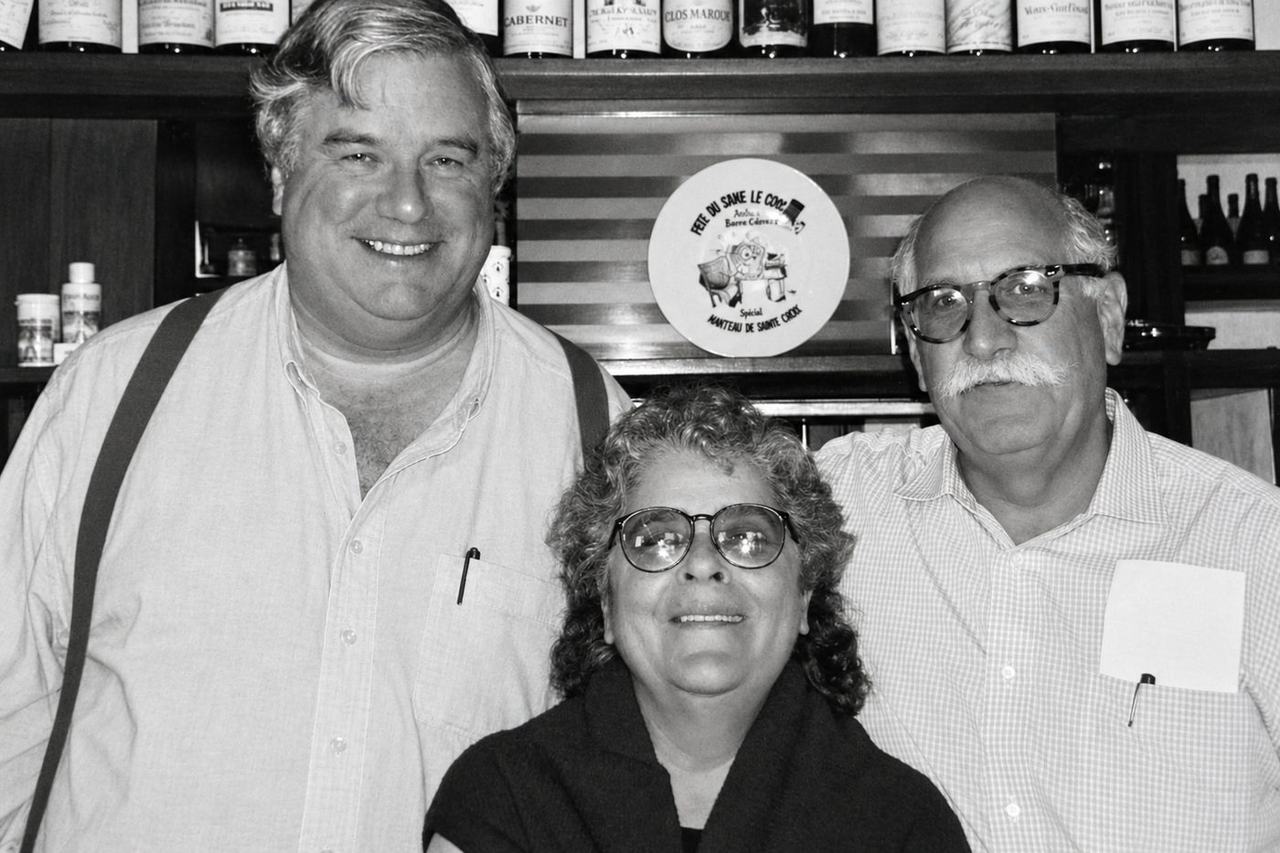
Starting out · Russell Hone, Becky Wasserman and Michael Feuerstein
In French, pas mal means “not bad.” It is what the French say when something is very, very good. A dear friend who worked beside Karl Lagerfeld at Chanel says it was his highest praise. Pas Mal is named for that: wines, and people, that let the work speak.
We did not set out to collect famous names. We set out to find growers whose wines taste like somewhere: a particular slope and soil, and one family’s way of thinking about both. That is how, with Becky Wasserman’s guidance, we came to import a young Sylvain Pataille in Marsannay, a village most of Burgundy overlooked, long before anyone else was paying attention.
That conviction also took us to Savigny-lès-Beaune and the Pavelot family, whose La Dominode and Les Lavières sit a few hundred metres apart and cannot be mistaken for one another blind. To Irancy, because when we asked a three-star sommelier in Joigny who the best grower in the village was, he said “Colinot” without pausing, and we drove there that afternoon. We have never had a contract with a grower; every relationship is a handshake.
“I saw a certain emotion when wine drinkers had a chance to meet the people who actually tilled the soil and made the wine.”
Becky Wasserman, to Decanter
Burgundy and Champagne are the heart of the book and always will be. Around them are the parts of France we love for the same reasons: the Loire, the Jura, Alsace, and Châteauneuf-du-Pape with Château de la Font du Loup.
Italy came later, and we approached it the way we approached Burgundy: through someone who had spent a lifetime in the cellars. Many of our Italian growers come to us through Marc de Grazia Selections, run today by Sebastian de Grazia, whose eye for the small estate in the overlooked village matches our own. The result is a book that runs the length of the country: Nebbiolo from the Barolo hills and the volcanic soils of Alto Piemonte, Sangiovese from Montalcino and Chianti Classico with Podere Brizio and Dievole, Cabernet Franc from Bolgheri with Tenuta Meraviglia, and on south through Campania and Puglia to the Nerello Mascalese of Mount Etna.
And we have found, in California and Oregon, growers thinking in a thoroughly Burgundian way about Pinot Noir and Chardonnay. On the Sonoma Coast, Senses and Small Vines farm cool, fog-bound sites with the kind of attention to row spacing and vine density you would expect in Vosne. At Fort Ross-Seaview, Wayfarer works a single ridgetop vineyard a few miles from the Pacific. In Oregon, Cowhorn and Johan farm biodynamically in the Applegate and Willamette Valleys. Napa is here too (DANA Estates, Hourglass, Robert Foley), because a great Cabernet from a specific hillside is as much a wine of place as any premier cru, and we would rather sell one that tastes of its mountain than one that tastes of its consultant. The accent changes from one coast to the other. What we look for doesn’t.
Every member of our sales team spent years on your side of the table. We bought for restaurants and shops, wrote lists, and sat through the Tuesday-afternoon parade of reps. We know the drill. We won’t show you forty wines and hope one sticks. We’d rather find the two or three wines in our book that belong on your list and will still make sense in a year.
We taste everything we sell. We will tell you when a wine is young or closed, and when it isn’t for you. The wines in our book are there because we believe in them.
Pas mal, in other words.
Fourth and fifth generations: sons taking over from fathers, daughters from mothers, brothers working side by side. These are households before they are businesses, and it shows in the glass.
Nearly all of it comes from land the family holds and works itself, in Champagne and the Côte d'Or, on Etna and the Sonoma Coast. We look hard for growers who farm their own ground, and when one buys a little fruit it is from a neighbour they know.
Fifty-nine of our houses are certified organic or biodynamic, and nearly all the rest farm sustainably. They farm that way because they intend to hand the land on.
