
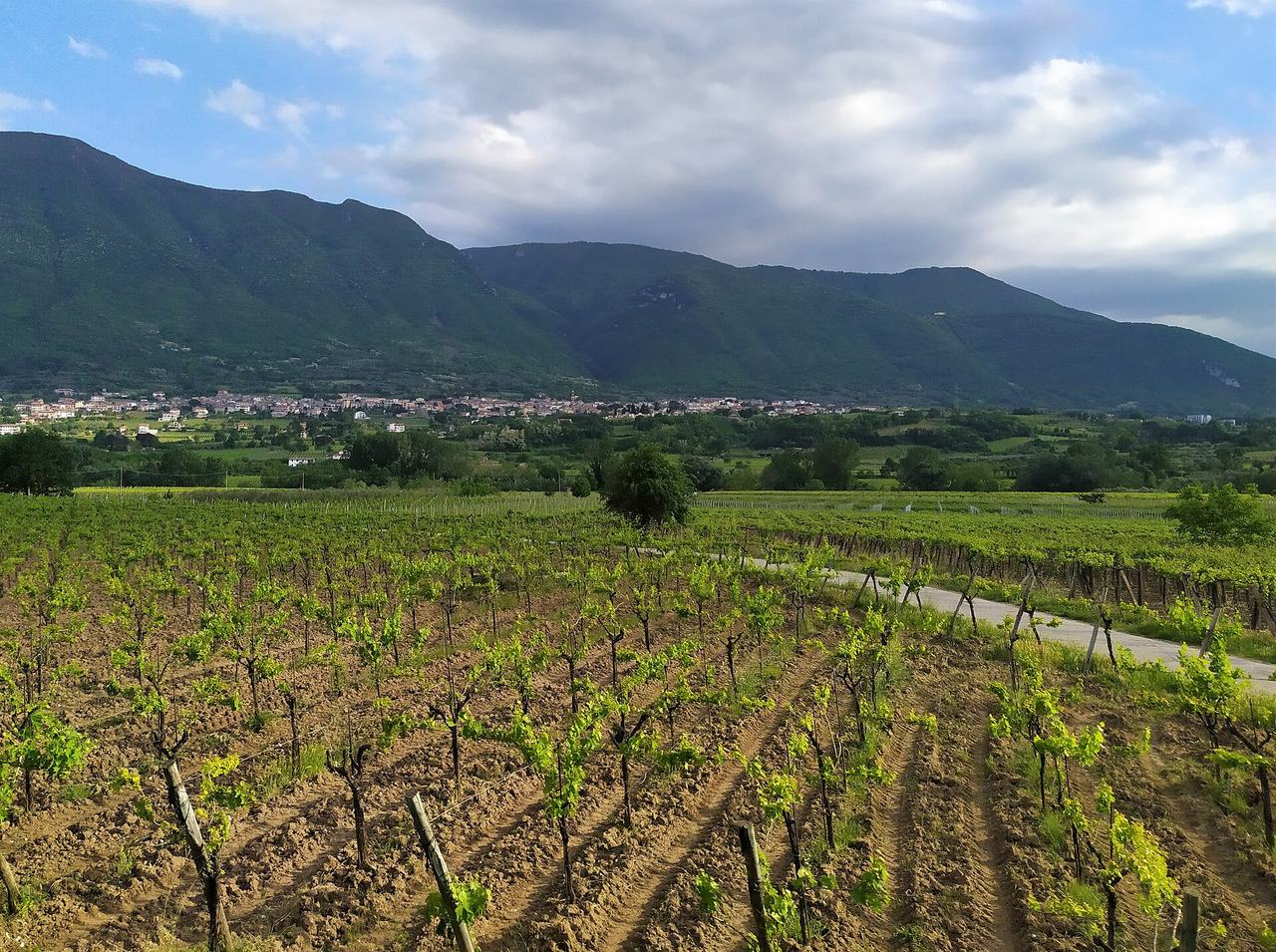
The growers of southern Italy’s most planted village, bottling their own grapes.
The interior of Campania (Samnium, the old land of the Samnites) is where the south’s own grapes go to be themselves, far from the coast and the tourists. Vigne Sannite is the wine arm of a farmers’ co-operative in Castelvenere, a village in the Calore valley north-west of Benevento where vines cover more of the land than in any other comune of central and southern Italy. The members farm their own plots and bring the grapes to one cellar on the edge of the village, which bottles the natives under one name: Falanghina, Fiano, Greco and Coda di Volpe among the whites, Aglianico for the reds.
It is a co-operative model, which I usually approach warily. Here the focus is narrow and the varieties are the point. The fruit comes from about 100 hectares of members’ vines in the Sannio, the largest wine district in Campania, on clay and limestone between 200 and 600 metres. The cellar keeps out of the way: the whites see only steel, the Aglianico only old barrels.
This is where the value lives in southern Italian white wine, and it lives here in quantity. These are bottles to open all year, and they last far longer than their modesty suggests. In 2025 the Campanian critic Luciano Pignataro opened a 2011 Falanghina from Vigne Sannite in magnum and wrote about its power and freshness. It is the best argument I know for buying these wines by the case.
02 · The co-operativeA farmers’ consortium that decided to make its own wine.
Vigne Sannite belongs to Cecas, the Centro Cooperativo Agroalimentare Sannita, a consortium of farm co-operatives in the province of Benevento. One of its members is the Cantina di Castelvenere. Cecas also runs a supply business for its growers, selling them everything from tractors to diesel. In the early 2000s it decided to take the members’ grapes further than the bulk market, and in 2005 it opened a modern winery at Località Salella, on the edge of Castelvenere where the Telesina road turns off for Cerreto Sannita. The first vintage bottled under the Vigne Sannite name is 2005.
The arrangement is the old one of the Italian south. Members farm their own vineyards and deliver the grapes; the cellar sorts them, makes the wine and sells it. Pignataro’s profile of the winery (2026) counts about 100 hectares of members’ vines and some 100,000 bottles a year, with Lucio Meola as oenologist. Cecas is now led by Gennarino Masiello, a national vice-president of the farmers’ union Coldiretti.
Every November the winery opens its doors to the members and their friends at the end of harvest, with roast chestnuts and a first taste of the new wine. In 2015 the president at the time, Nicola Mastrocinque, used the evening to thank the growers for the extra work asked of them in recent years to raise the quality of the wines.
Un grazie forte e sentito, anche alla luce dei tanti impegni in più richiesti in questi ultimi anni, al fine di elevare il livello qualitativo dei vini prodotti.
Nicola Mastrocinque, president of Cecas, to the members, November 2015
03 · CastelvenereA village with more vineyard than anything else.
Castelvenere sits at 119 metres in the valley of the Calore, a tributary of the Volturno, with the Matese mountains to the north and about 2,400 people. The Touring Club Italiano calls it the most planted comune in central and southern Italy, measured as vineyard against total land. In 2019 it shared the title of European City of Wine with the other towns of the Calore valley. Under the medieval village, hollows cut for grey tuff in the Renaissance were later widened into cellars, and on the last weekend of August the wine festival is held in them.
The members’ vineyards climb from about 200 to 600 metres on the slopes round the valley. The cellar describes the ground as a medium-textured mix of clay and limestone, broken by outcrops of sandstone and volcanic rock, and the vines average about 25 years. The height and the limestone help the whites keep their acidity through a southern summer.
The village has a red of its own: the grape the Sannio calls Barbera, now also known by its old name, Camaiola. Small, dark berries give a deep ruby wine that Cecas describes as smelling of roses. Vigne Sannite bottles it as Sannio Barbera, alongside Piedirosso and Aglianico.
04 · Vineyard and cellarGrass between the rows, steel for the whites.
By Cecas’s own account, the work that mattered was done in the vineyards. The members moved to gentler methods: grass cover on almost all the land to keep weeds down, and only environment-friendly treatments. Mastrocinque told the magazine Eccellenze Sannite that the aim was a wine made with as little chemistry as possible, using, for example, a third of the sulphites the law allows. We list the farming as sustainable; we have seen no certification.
The cellar is simple and modern. Fiano, Greco and Coda di Volpe ferment at controlled temperature in stainless steel and rest on their lees for six to eighteen months before bottling. The Aglianico is raised in neutral oak, so the wood shapes the texture and leaves the fruit alone. Yields are what you would expect of a co-operative: eight to ten tonnes a hectare for Greco, ten for Fiano, twelve for the more generous Coda di Volpe.
05 · The winesGrapes the Romans wrote about, made to last.
Each of these grapes has a long past in Campania. Coda di Volpe, the fox’s tail, is named for the shape of its bunches; Pliny the Elder called it Cauda Vulpium. Greco is traced to the Aminea gemina vine that Columella, Virgil and Pliny all mention; its bunches are small and winged, and it ripens late for a white grape, between the middle and the end of October. Fiano is the one the cellar singles out for ageing: it says some of its qualities keep growing after two years in bottle.
Pignataro’s note on the 2011 Falanghina makes the same point for the whole range. A steel-raised white from a hot year, kept in magnum for over a decade, it still showed what he called l’incredibile potenza e freschezza (incredible power and freshness), and he took it as proof of the grape that, more than any other, stands for Campania.
The Aglianico comes from the same clay and limestone and spends its time in old barrels, so the grape’s dark fruit and firm tannin come through without a coat of new wood. The vintage we bring, 2018, arrives with several years already behind it. With the three whites beside it, that is a whole southern Italian table from one village.
In the vineyard
& cellar.
- Holding
- About 100 hectares farmed by member growers around Castelvenere
- Since
- 2005, first bottled vintage; winery at Località Salella, Castelvenere
- Who
- Wine arm of Cecas (Centro Cooperativo Agroalimentare Sannita); oenologist Lucio Meola
- Vines
- 200–600 m; clay and limestone with sandstone and volcanic outcrops; about 25 years old
- Grapes
- Falanghina, Fiano, Greco, Coda di Volpe; Aglianico, Piedirosso, Barbera
- Farming
- Sustainable; grass cover between the rows
- Cellar
- Whites in stainless steel, 6–18 months on lees; Aglianico in neutral oak; about 100,000 bottles a year