A small museum of geology, treated one argument at a time.
The Geyls have been making wine at Beblenheim since about 1795, which is the kind of date that ought to make a domaine complacent, and hasn't. Jean-Christophe Bott came home in 1993 after working at Comtes Lafon and in the Barossa, and within three vintages was named Vigneron of the Year. He holds pieces of six Grands Crus (Schlossberg, Schoenenbourg, Sonnenglanz, Furstentum, Mandelberg, Sporen), which in Alsace is a small museum of geology, and he treats each one as a separate argument. Fermentations run on wild yeast for three to six months. Nothing is chaptalised, nothing is fined. His son Pierre-Antoine has joined him. The wines are crystalline in a way that takes patience, not technique.
02 · Two families, two villagesBrewers in Ribeauvillé, growers in Beblenheim, and a wedding in 1926.
The Botts were brewers in Ribeauvillé in 1775 (the date on the family’s letterhead refers to beer, not wine), and only later did one branch turn to selling wine and another to growing it. The Geyls were the vignerons, on the slopes above Beblenheim, where Jean-Martin Geyl was already making his own wine at the end of the eighteenth century; the guides round that to 1795, and the family, more carefully, does not give a year. On the 27th of October 1926 Andrée Geyl married Frédéric Paul Bott and moved to Ribeauvillé. Her sister Suzanne stayed and ran the Beblenheim vines alone.
It was Andrée’s son Édouard who put the two names together. After two years of viticultural school in Beaune and one in Strasbourg he went to work beside his aunt in Beblenheim, and the domaine as it exists today (Bott hyphen Geyl) dates from that. In the early years the grapes were trucked to Ribeauvillé to be made into wine with whatever was to hand; the first bottling in the village itself was 1961. Over forty years Édouard took four hectares to fourteen, built the cellar, married Annette Schmidt of a Riquewihr growing family whose grandfather had worked in the German cooperages, served a quarter of a century as mayor of Beblenheim and became Grand Master of the Confrérie Saint-Étienne, the Alsace wine brotherhood. He was still pouring for visitors in the tasting room in his seventies when his son was away.
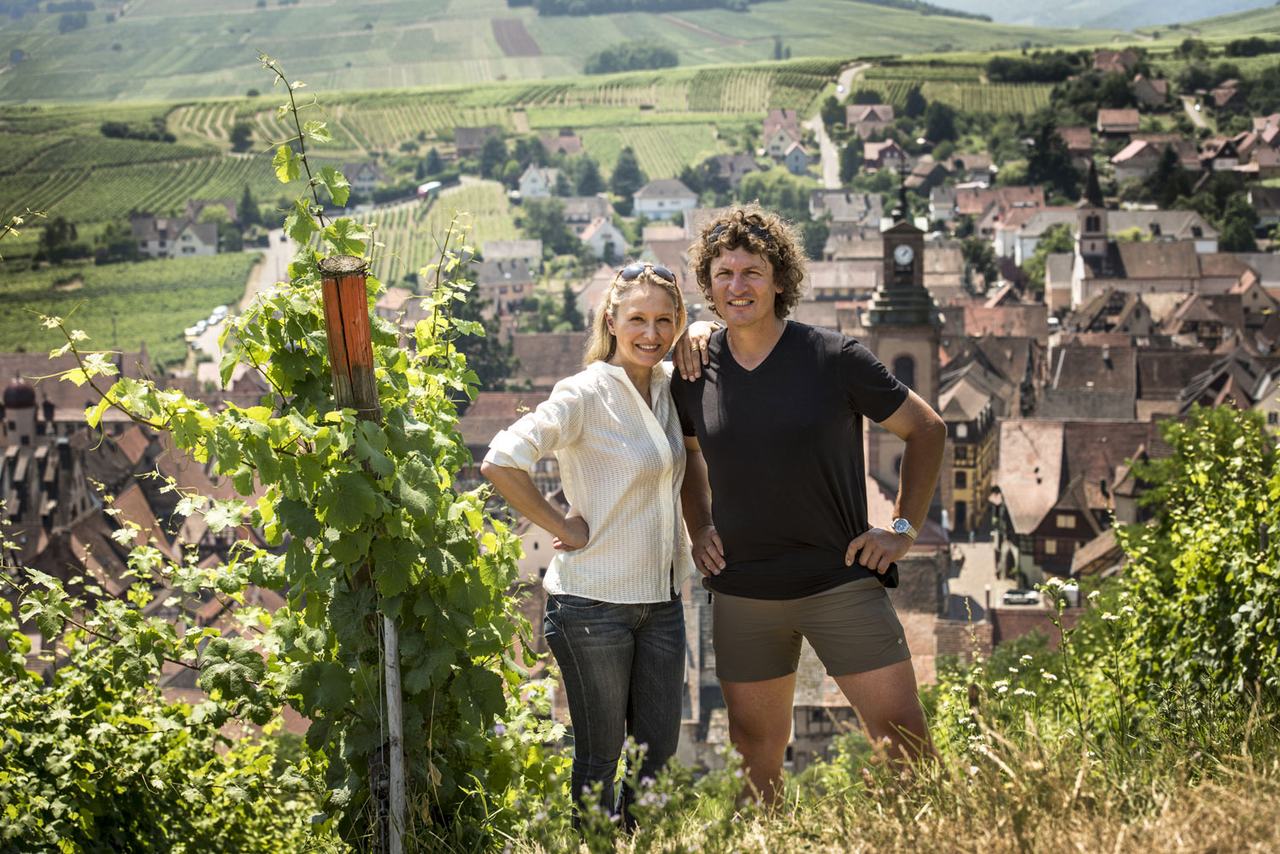
Jean-Christophe is that son. He went round the world with a knapsack before he came back: the Comtes Lafon in Meursault, Théo Luckert in Franconia, Rolf Binder’s Veritas in the Barossa, Koopmanskloof in Stellenbosch. He was twenty-four when he took the domaine in 1993. Gault & Millau named him Vigneron de l’Année in 1996, after three vintages, and in 2026 La Revue du Vin de France gave the domaine its third star, the top of the scale, held by a handful of Alsace estates. His wife Valérie works beside him, and it was Valérie, the family says, buying organic vegetables for the house, who started the argument that converted the vines. The elder son Pierre-Antoine, who trained with Pascal Agrapart in Champagne among others, joined in 2024; the younger, Arnaud, is training too.
Le temps long, source d’émotions.
The motto on the Bott-Geyl door
03 · Six grands crusGranite, gypsum marl, Oligocene pebbles, Dogger limestone, dolomite and Lias clay, all within twenty minutes’ drive.
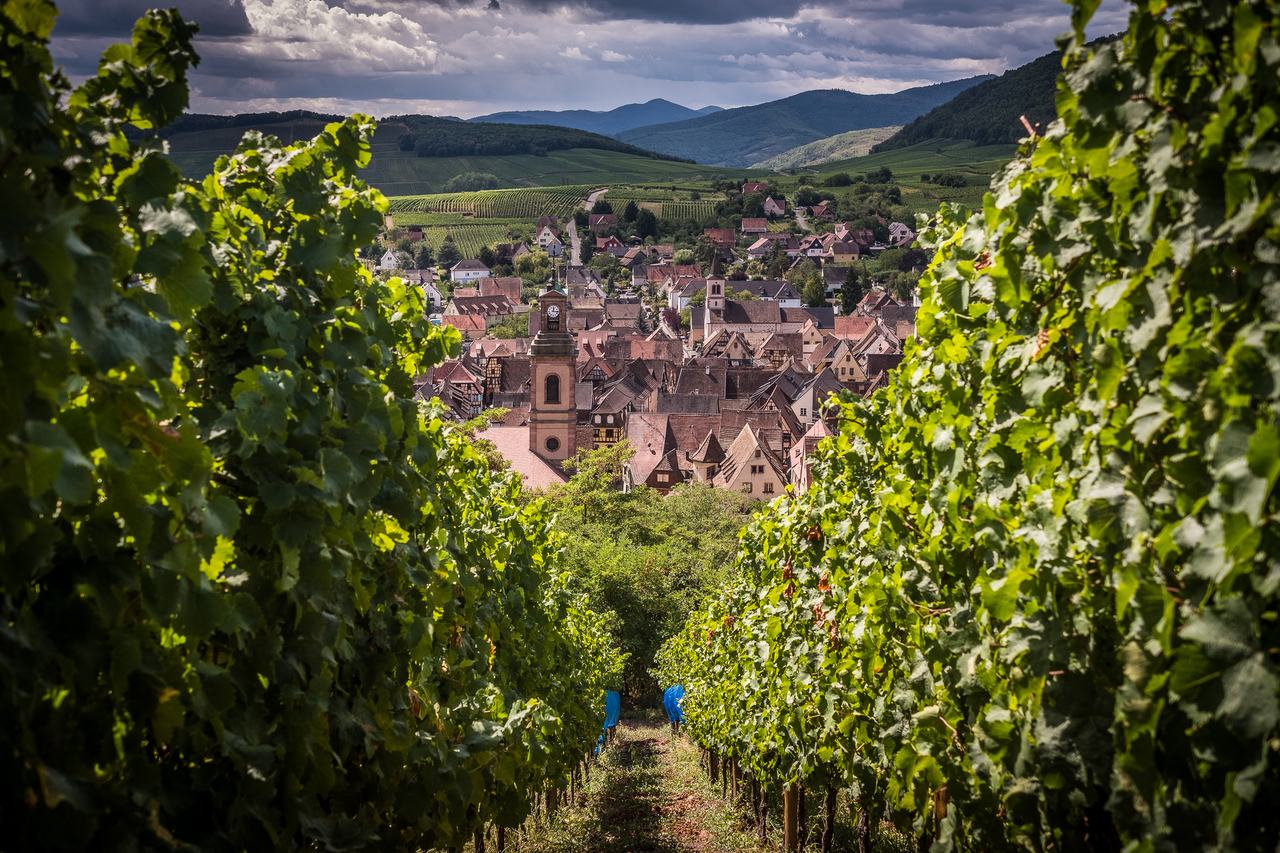
Eighteen hectares in seventy-five parcels over seven villages, from Ribeauvillé to Kientzheim, between 220 and 400 metres. The point of the spread is the rock. Schlossberg, above Kientzheim, is granite (weathered arenas of the Kaysersberg migmatite), and the domaine’s parcel is the lieu-dit Im Tal, high in a combe, south-facing but shaded, which is what Krebiehl meant by “lemon juice on stone.” Schoenenbourg, the great hill over Riquewihr that Voltaire called the noblest wine of the country, is the Keuper’s gypsum-bearing marls under a skin of Vosges sandstone and Muschelkalk; the domaine’s half-hectare sits mid-slope with fifty- and sixty-year-old Riesling, and it is the wine the RVF scored highest, 97 for the 2021. Sonnenglanz is home: the Beblenheim grand cru, southeast over Oligocene limestone pebbles and marl in one of the driest spots in Alsace, 500 millimetres of rain in a year. The family has 1.3 hectares each of Pinot Gris and Gewurztraminer there, and it is the botrytis terroir: three Hachette coups de cœur in ten years came from it. Above it, on the stoniest ground, the only red: Pinot Noir planted densely in 1991 and bottled as Galets Oligocène.
Furstentum, between Sigolsheim and Kientzheim, is the hot one: full south, 350 to 400 metres, a scree of marl, limestone and sandstone over the Dogger, with Mediterranean plants on the terraces; Pinot Gris mostly, and the wines are aerial rather than heavy. Mandelberg, on the Mittelwihr side of Beblenheim, is dolomitic limestone, 28 ares of Riesling with a chalky acidity. Sporen, the natural amphitheatre south of Riquewihr on decalcified Lias clay, came last, in 2012, fifteen ares of Riesling the family calls Très Vieilles Vignes because the vines are nearer a hundred years than eighty. Reinhardt of the Wine Advocate calls Sporen one of his favourite terroirs in Alsace “due to the subtleness and finesse of its wines.”
Around the grands crus are three named lieux-dits and a clos. Grafenreben, the Count’s vines, calcareous marl at Zellenberg next door to Schoenenbourg, Riesling of ample, sweet-edged acidity and the home of the botrytis wines. Kronenbourg, the crowned hill, also at Zellenberg, an extension of Schoenenbourg on brown, faintly calcareous marl with quartz pebbles, fifty-year Riesling and the driest wine in the cellar. Schloesselreben at Beblenheim, limestone, Gewurztraminer. And the Clos des 3 Chemins at Mittelwihr, a hectare in all, half of it the domaine’s, planted to Gewurztraminer between the wars and first harvested under its own name in 2013. A Sorbonne soil study of the 1970s ranked it one of the two best Gewurztraminer sites in Alsace. Two more grands crus are coming: a share of Osterberg at Ribeauvillé, leased in 2024 with Jean Boxler and Félix Meyer of Meyer-Fonné, and a small inherited piece of Rosacker just under the Clos Sainte Hune. For now those grapes still go to the co-operative; in time they will not.
Ici, le cépage s’efface devant l’éloquence du terroir.
Jean-Christophe Bott
04 · UmamiOrganic in 2000, biodynamic in 2002, and a label that tells you how sweet the wine is.
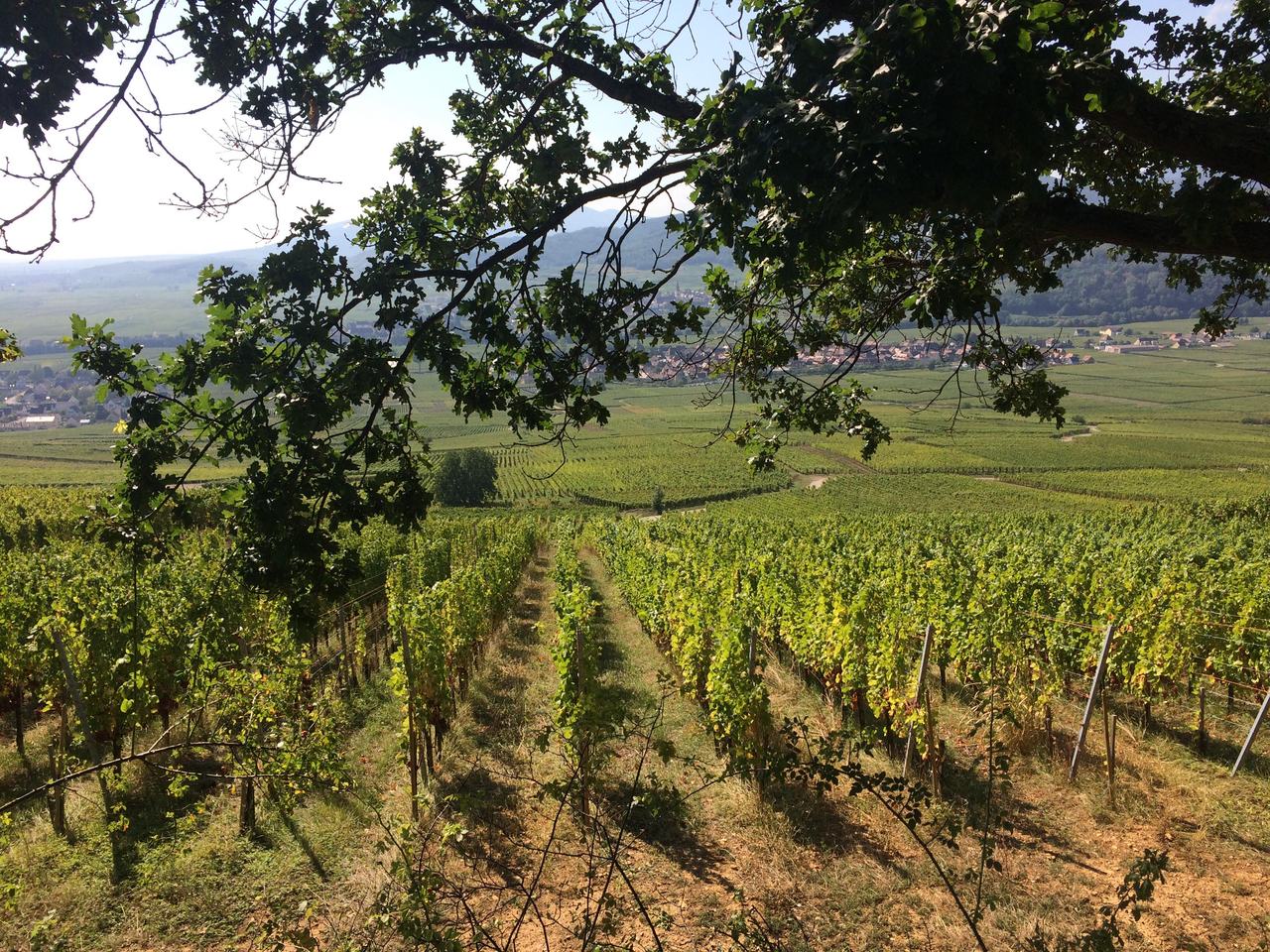
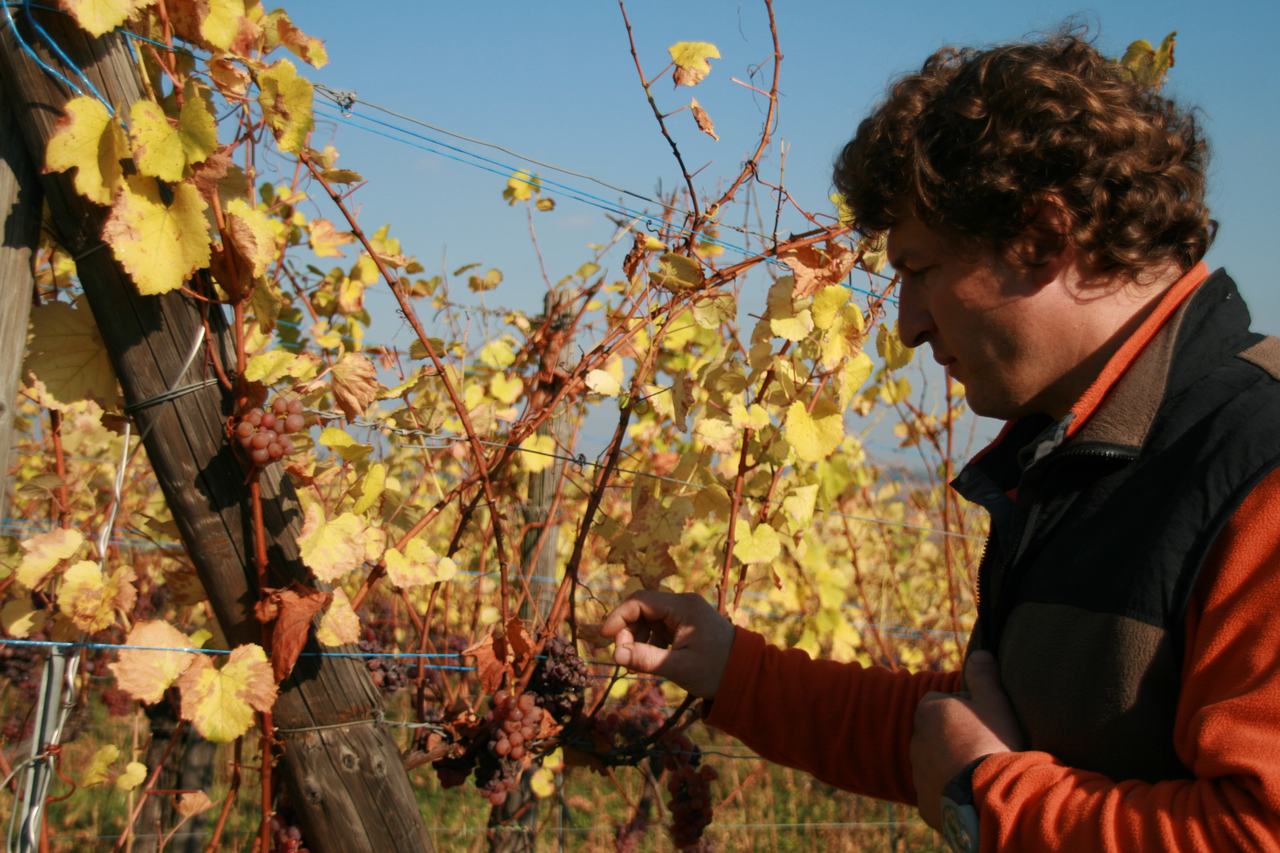
Organic from 2000, biodynamic from 2002, certified by Ecocert and a member of Biodyvin since 2004. The preparations are the usual ones (horn manure, horn silica, Maria Thun compost, teas of chamomile, nettle and horsetail), plus a thing the family is specific about: young vines are hoed hard to kill the surface roots and force the plant down. Massal selections planted densely on low-vigour rootstocks, which is the long way of saying that the vines were ready for the dry years before the dry years came. Yields are low, forty hectolitres a hectare in a normal year, and 2021 took half to four-fifths of the crop to frost and mildew. He picks late, from the shaded parcels, for ripeness without alcohol.
Hand harvest into forty-kilo crates, emptied at once; whole bunches pressed slowly, six to eighteen hours depending on the grape and its health; gravity to tank; a cold settling; and then the wild yeasts start in three or four days and take between three and six months to finish. Ni enzymés, ni chaptalisés, ni levurés, ni collés: no enzymes, no sugar, no bought yeast, no fining. Four to eight months on fine lees, bottling around September, and then the part that sets the house apart in Alsace: the wines wait. The RVF notes that Bott-Geyl releases roughly two years after its neighbours, and Krebiehl that every wine “is always released with some bottle age.”
Two things to say plainly, because the trade asks. First, this is not a bone-dry house and does not pretend to be: every label carries a sweetness index from 1, très sec, to 9, liquoreux. The Rieslings are mostly dry; the grand cru Pinot Gris and Gewurztraminer carry twenty-odd grams and wear it well. Second, the word Jean-Christophe uses for what he is after is umami, the savoury , nourishing quality that the RVF, independently, used to describe the wines. “I’m looking for a vibrato,” he says, “a tension, something airy, chiselled. It’s a bit like my philosopher’s stone.”
Seul un raisin de grande qualité permet de rêver un grand vin.
Jean-Christophe Bott
05 · What they say“Un styliste majeur du capricieux pinot gris.”
La Revue du Vin de France, awarding the third star in its 2026 Guide Vert: “Jean-Christophe excels in the expression of each grape — formidable Rieslings, of course, but he also stands as a major stylist of the capricious Pinot Gris. His wines take on a nourishing character, often marked by umami. This uncompromising commitment to quality is today rewarded with a third star.” Scores to match: 97 for the 2021 Riesling Schoenenbourg and the 2018 Pinot Gris Sonnenglanz SGN, 96 for the Gewurztraminer Sonnenglanz and the Sporen Très Vieilles Vignes. Anne Krebiehl MW in Vinous, on the 2021s: “astonishingly bright and strikingly good… The Les Éléments range stands out for overdelivering at the entry level.” On the 2020 Schoenenbourg, 97: “absolutely concentrated and profound, yet weightless, linear and serene.” On the 2020 Pinot Gris Sonnenglanz, 95: “Everything here is elongated, transforming the nature of Pinot Gris into athleticism.” Her verdict on the house: “on a great trajectory.”
Stephan Reinhardt in the Wine Advocate, 94 on the 2015 Schoenenbourg: “It is not the sweetness that makes the 2015 Schoenenbourg a great Alsace Riesling but its richness, finesse and elegance.” James Suckling, 95 on the 2016 Galets Oligocène: “So much minerality, depth and finesse, all in one slender package.” Julia Harding MW on the 2014 Kronenbourg: “Bone dry and the ageing has given complexity but without loss of the excellent freshness. Long and mouth-watering.” Bettane & Desseauve: un toucher de bouche singulier, a style “often apart in the Alsace landscape.” And Gault & Millau, thirty years after the first award: “Every bottle has a soul and the wines their own style — a sign that singularity is not the preserve of small estates.”
Absolutely concentrated and profound, yet weightless, linear and serene.
Anne Krebiehl MW, Vinous, on the 2020 Riesling Schoenenbourg
In the vineyard
& cellar.
- Holding
- Eighteen hectares in seventy-five parcels over seven villages, Ribeauvillé to Kientzheim, 220–400 m; six grands crus (Schlossberg, Schoenenbourg, Sonnenglanz, Furstentum, Mandelberg, Sporen), three lieux-dits (Grafenreben, Kronenbourg, Schloesselreben) and the Clos des 3 Chemins; Osterberg and Rosacker coming into production
- Since
- Geyls growing at Beblenheim from the late eighteenth century; Bott and Geyl joined by the 1926 marriage; the domaine built by Édouard Bott, first bottled in situ 1961; Jean-Christophe Bott from 1993; sons Pierre-Antoine (joined 2024) and Arnaud
- Grapes
- Riesling, Pinot Gris, Gewurztraminer, Pinot Noir, Muscat, Pinot Blanc, Auxerrois, Chardonnay (crémant), Sylvaner, Chasselas
- Farming
- Organic 2000, biodynamic 2002; Ecocert and Biodyvin (member since 2004); massal selections, dense planting, low-vigour rootstocks; ~40 hl/ha; hand harvest into 40-kilo crates
- Cellar
- Whole-bunch pneumatic pressing 6–18 hours; gravity; cold settling; indigenous yeasts, 3–6 months’ fermentation; no enzymes, chaptalisation, cultured yeast or fining; 4–8 months on fine lees; bottled around September; Pinot Noir 40–50% whole bunch in Burgundian pièces
- Release
- Held in bottle; released roughly two years later than the Alsace norm. Every label carries a sweetness index from 1 (very dry) to 9
- Honours
- Gault & Millau Vigneron de l’Année 1996; La RVF Guide Vert three stars, 2026