
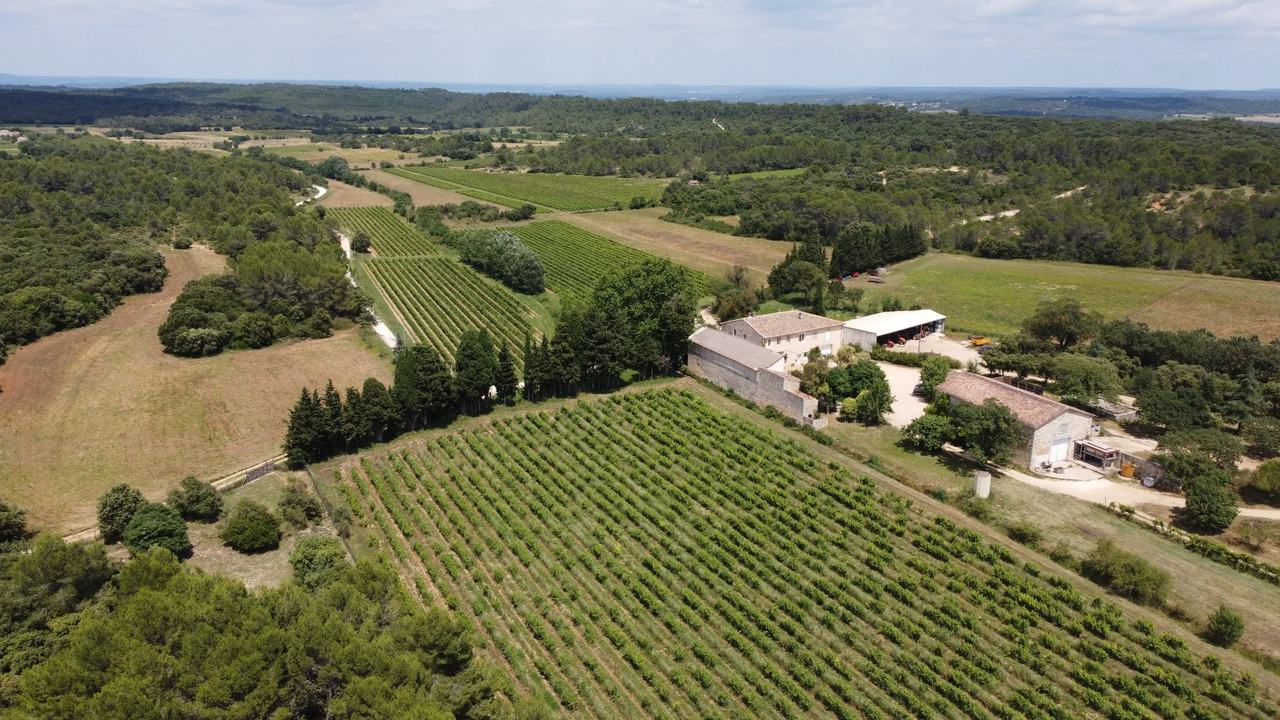
A whole farm in the garrigue, and the vines are only one part of it.
Denys and Agnès Armand don’t only grow grapes. There are old wheat varieties, beehives, olive trees, truffle oaks, a vegetable garden, poultry, and a flock of sheep that grazes the vines from October to March. Their rule, in their own words, is to produce what they consume and consume what they produce. That is the actual mechanism. A farm with animals and other crops in it behaves differently from a monoculture, and the wines carry a lift and an aromatic clarity you can taste before you know why.
The mas is a nineteenth-century farmhouse in the Massif des Lens, the garrigue hills between Uzès and Sommières on the north-eastern edge of the Languedoc, where the Gard runs up toward the Cévennes. It was abandoned when Denys arrived in 1980. Garrigue on all sides, a hundred and eighty metres up, the Mistral drying everything, cold nights holding the acidity.
Certified organic since 2009 and biodynamic since 2011, the Armands make whites that most of the Languedoc doesn’t attempt: Grenache Blanc, Picpoul and Viognier raised on their lees in foudre, Chenin in demi-muid and amphora. Nothing is forced anywhere.
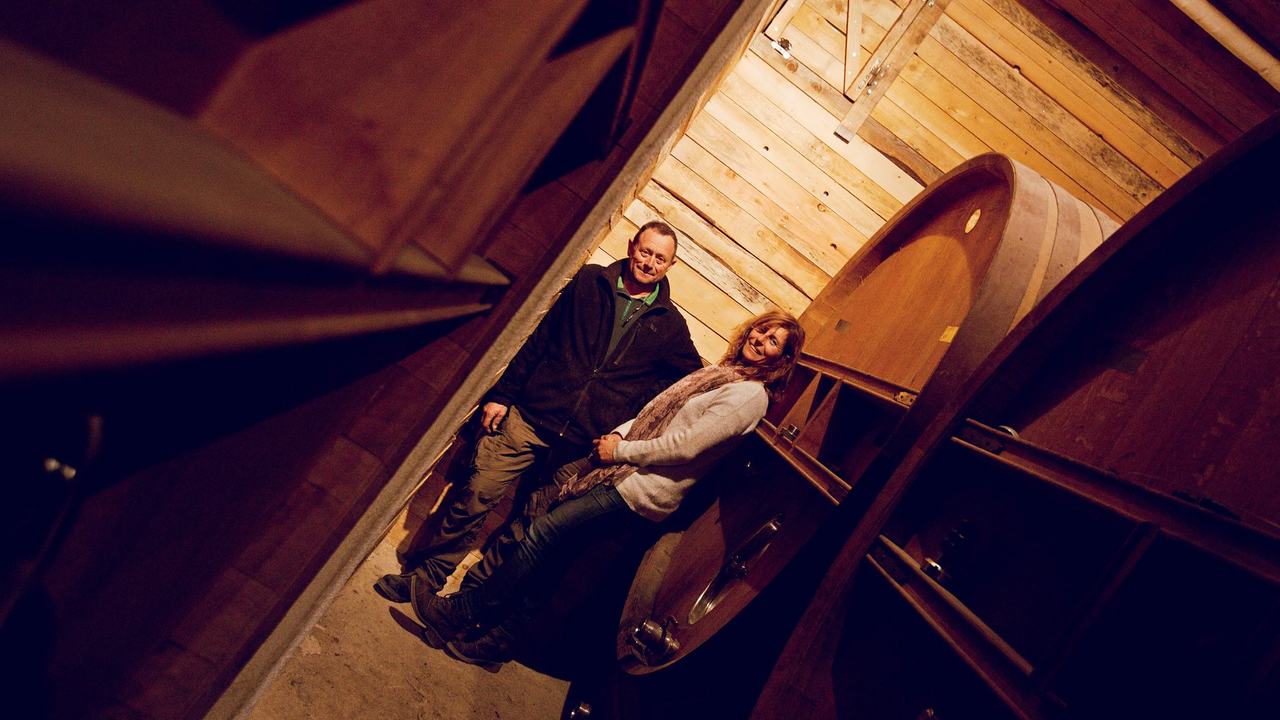
02 · Denys and AgnèsAn abandoned mas, rebuilt from 1980, and out of the cooperative in 1999.
Denys Armand comes from generations of vignerons and bouilleurs de cru, the farmers with the old right to distil their own spirit. When he settled at Mas d’Espanet in 1980 everything had to be done. He kept the old Languedoc red vines that were still there, Grenache Noir, Carignan and Cinsault, some of them now past fifty years old, and planted white varieties the estate had never had: Grenache Blanc and Gris, Sauvignon, Viognier, Clairette, Picpoul, Chenin.
For nearly twenty years the grapes went to the cooperative. In 1999 Agnès and Denys left it to make their own wine. They restored the cellar, turned the old sheepfolds into a barrel room, and began to vinify about twenty hectares. The cellar is half underground, so the wine moves by gravity.
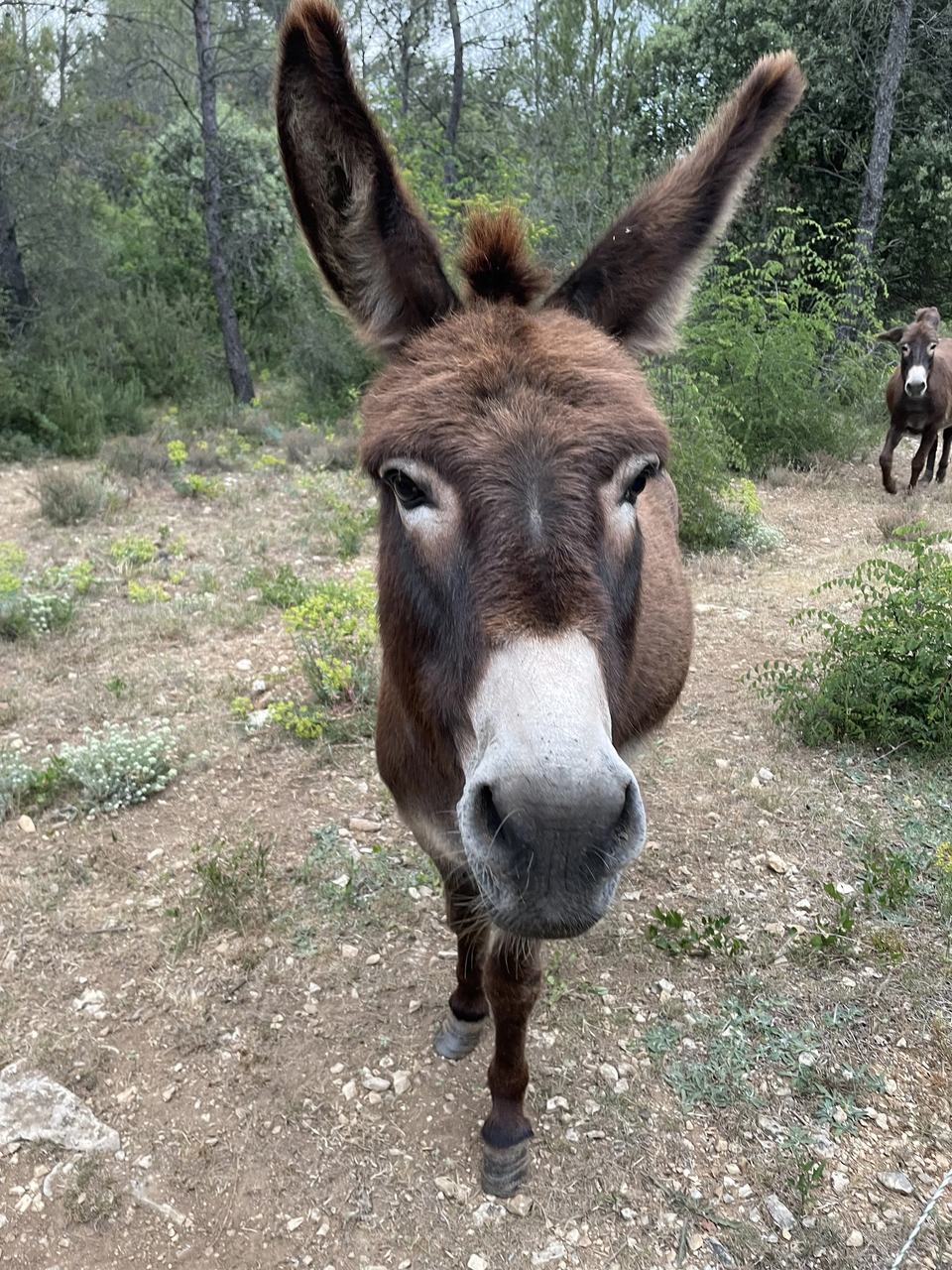
It is still a family affair. The estate’s own page lists the team by first name, Agnès, Denys, Guillaume and the rest, down to Aramon, one of the farm’s animals, whose photograph is on the site with everyone else’s.
Produisons ce que nous consommons et consommons ce que nous produisons.
Denys et Agnès Armand
03 · Two climatesLimestone hills where the Languedoc meets the Cévennes.
Saint-Mamert-du-Gard sits on the north-eastern border of the Languedoc, under two climatic influences, as the estate puts it. The vineyard is scattered through the garrigue on a wide range of soils and exposures, mostly clay-limestone with bands of red and yellow marl, and the Armands planted each variety where they thought it would do best. One plot is cool enough for Pinot Noir. “Du pinot qui pinote,” the tech sheet says of it: Pinot that tastes like Pinot.
The Mistral is the other part of the terroir. It dries the vines after rain, which matters on a farm that uses no synthetic sprays, and it brings cold nights. The estate puts the freshness of its wines down to that, to short pruning and disbudding that hold the yields, and to working the soil. It calls that freshness unexpected for the region, and it is right.
04 · The lunar calendarGrenache pruned on a descending moon, sheep in the rows all winter.
The vineyard work follows the biodynamic calendar. Grenache is pruned when the February moon is descending, ideally as the vines begin to weep sap. The soil is ploughed on fruit or root days; the earth is cleared from the foot of the vines and shallow-ploughed three times a year. Grass is left in part of the rows in summer and all of them in winter, when the sheep come in to graze. Treatments are copper, sulphur and macerations of horsetail and nettle. The organic conversion began in 2007, the certificate came in 2009, and Demeter followed in 2011.
Everything is picked by hand and sorted in the vineyard. Reds are made traditionally, with macerations of different lengths by variety and cuvée, and raised in tank and large foudres. Whites are destemmed and pressed directly, then fermented and raised on their lees in demi-muids of six hundred litres, foudres and amphorae. The Creta Amphora white spends three years in clay.
The whites are where the farm shows its curiosity. Chacun son Chenin is pure Chenin Blanc, fermented and aged for eight months in demi-muids and amphorae. Creta Amphora blends Sauvignon, Petit Manseng, Chenin and Riesling and leaves them on their lees in four-hundred-litre clay jars for three years, which gives a deep, spiced, gently oxidative white for the table. At the other end is Freesia, a young range made in tank for fruit and freshness: a white, a pale rosé of Cinsault and Grenache Gris, and a light red of Cinsault with old local varieties such as Ribeyrenc, Aubun and Counoise.
05 · ÉolienneThe white named for the wind pump in the middle of the vines.
Éolienne is the signature cuvée, and the name is literal: the white vines grow around an old wind pump, an éolienne, on the farm. The Guide Hachette noticed it early. Its 2005 edition gave the 2002 two stars, a vin remarquable, and told the story of the abandoned estate and the couple who left the cooperative to fly on their own wings. The current Éolienne Blanc is mostly Grenache Blanc, with Picpoul and Viognier, fermented and aged for a year on its lees in a 42-hectolitre foudre; there is a red Éolienne as well, from the old Carignan and Grenache.
La Revue du Vin de France includes the estate in its Guide des meilleurs vins de France, and in 2024 ran it in a feature on the Cévennes as a free and mysterious wine country. Alexis Goujard of the RVF tasting panel filmed a note on the 2013 Éolienne Blanc. Gault&Millau lists the estate too.
What they all respond to is a Languedoc white with freshness and real texture, from a farm that would make sense even without the wine. Drink the Éolienne with shellfish or grilled fish, as the Armands suggest, or with anything off the grill that has met some garrigue herbs.
Laisser le terroir s’exprimer.
Mas d’Espanet
In the vineyard
& cellar.
- Holding
- ~20 ha vinified · Massif des Lens, Saint-Mamert-du-Gard, between Uzès and Sommières · 180 m
- Since
- Denys Armand at the mas from 1980 · own bottlings since 1999, after leaving the cooperative
- Soil
- Clay-limestone with red and yellow marls, in garrigue · Mistral, cold nights
- Varieties
- Grenache Noir, Carignan, Cinsault (some vines 50+ years) · Grenache Blanc and Gris, Sauvignon, Viognier, Clairette, Picpoul, Chenin
- Polyculture
- Old wheat, bees, olives, truffle oaks, vegetables, poultry · sheep graze the vines October–March
- Farming
- Organic since 2009 · biodynamic since 2011 (Demeter) · lunar calendar, plant macerations
- Cellar
- Half-buried gravity cellar · whites on lees in demi-muid, foudre and amphora · reds in tank and foudre