
The supporting actor,
given the lead.
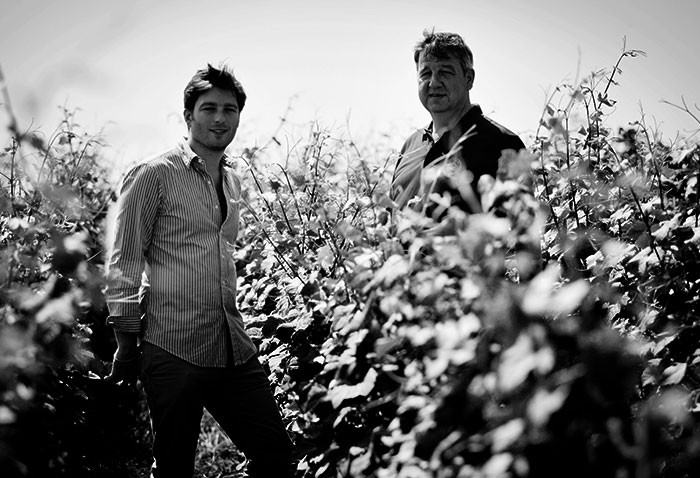
Meunier has spent a hundred years as Champagne's supporting actor: the grape you blend in for flesh and never mention by name. The Salmon brothers, Olivier and Alexandre, planted eighty-five per cent of their ten hectares to it and then had the gall to bottle it alone, ripe, unhurried, sometimes with no dosage at all to sweeten the argument. Their single-vineyard Special Clubs from Les Grèves and Les Ormes settle the question better than I can. Meunier isn't a lesser grape. It was just never given a serious cellar to grow up in. Now it has one.
02 · Three generationsFive hundred bottles, sold door to door.
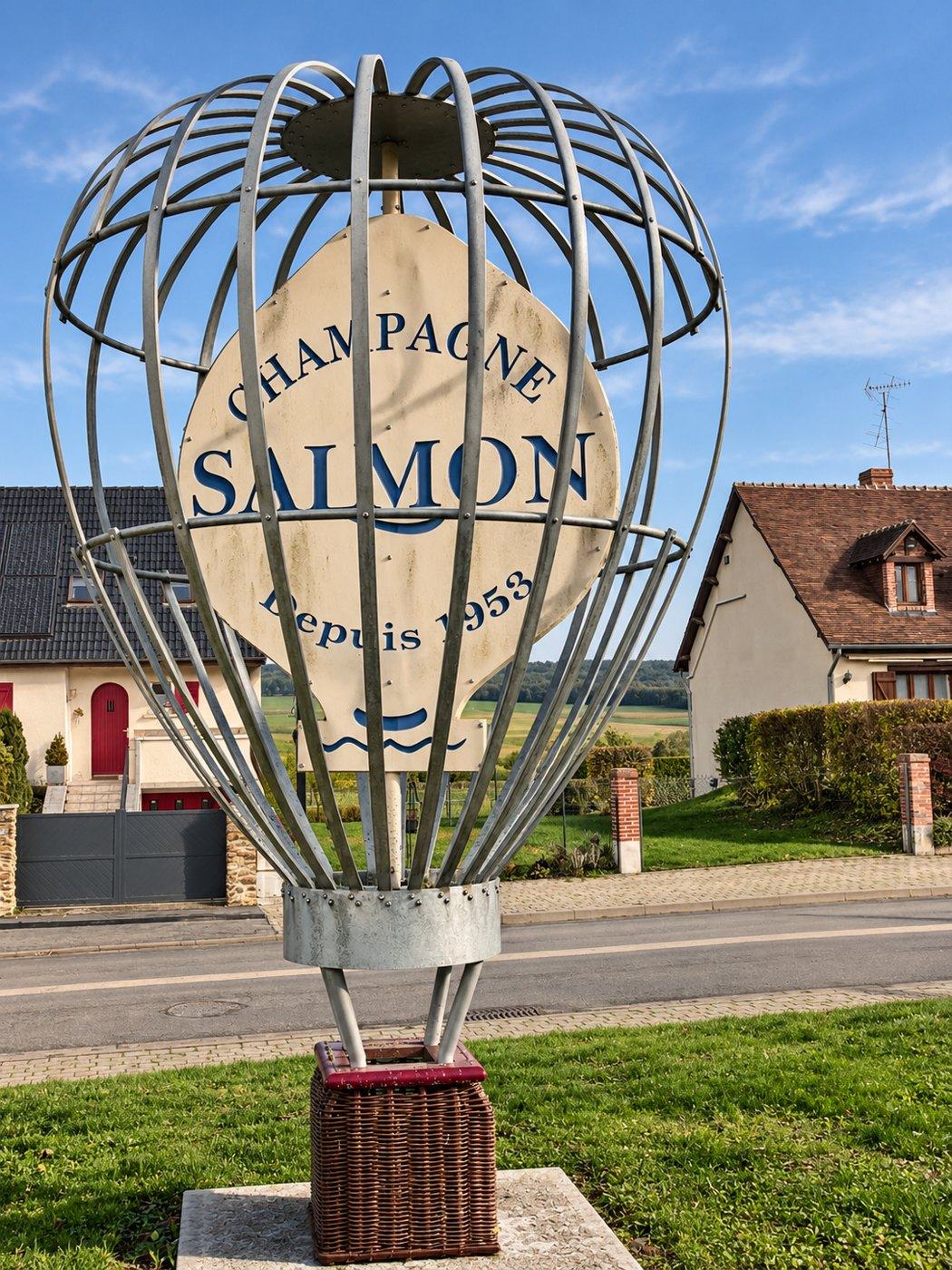
Michel Salmon was born in Chaumuzy, a village of a few hundred people in the Vallée de l’Ardre, the valley that runs west out of the Montagne de Reims toward Fismes. He spent most of his working life in other people’s vines before he had any of his own. The sign at the gate says depuis 1953; that is when he began gathering the small plots that would become the domaine. In 1958 he pressed his first harvest under his own name, about five hundred bottles, and sold them door to door. He is still there, and still leads the occasional tasting.
His son Olivier joined at the start of the 1980s and, in 1983, took the step that defines the estate to this day: he became a récoltant-manipulant, a grower who makes and bottles his own wine rather than selling grapes to the houses. For thirty years he held that line in a valley where most of the fruit still goes to Reims and Épernay by the truckload. Today the domaine makes roughly a hundred thousand bottles a year, and only about one in seven leaves France.
Alexandre, Olivier’s son, came home in 2003 and now makes the wines. The estate calls itself vignerons de père en fils depuis trois générations, and for once the phrase is literal: grandfather, father and son are all still on the property. Nobody here buys grapes. Ten hectares, all their own, and they have to live with every one of them.
03 · The balloonWhy a champagne house flies.
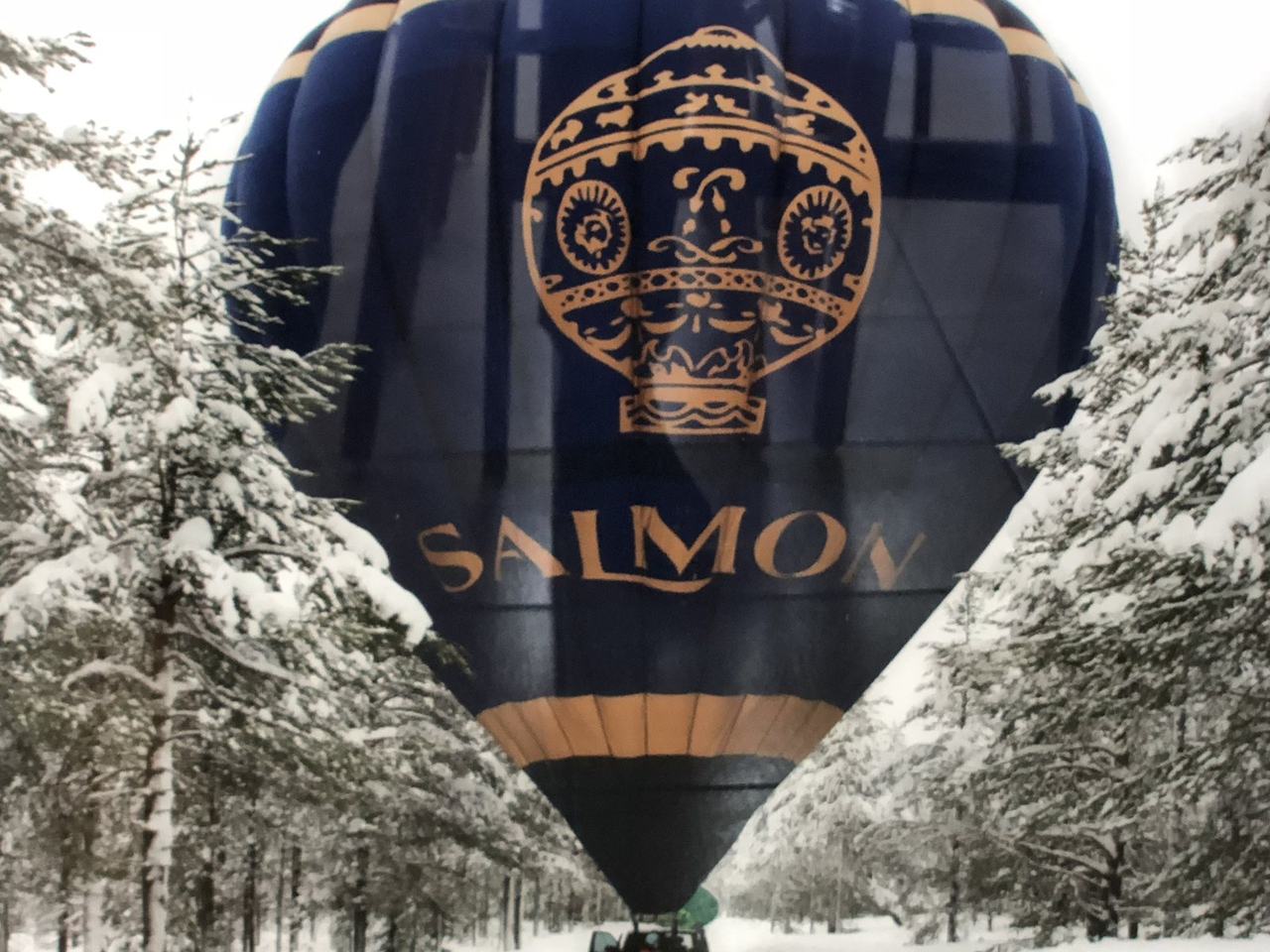
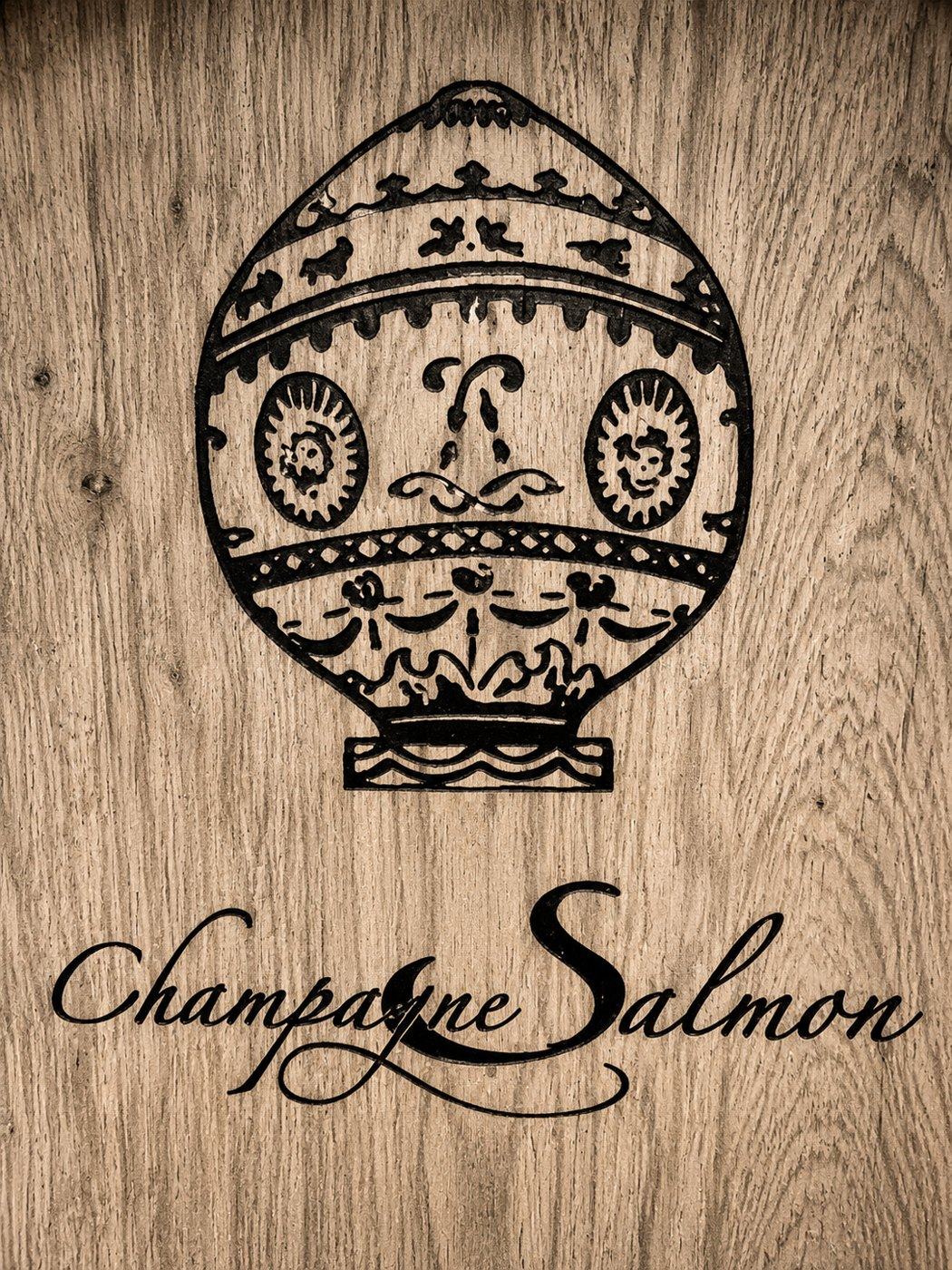
Every bottle of Salmon carries a Montgolfier balloon on the label: the ornate, sun-faced globe the brothers Montgolfier sent up over Annonay in 1783. A wrought-iron one stands outside the winery with a wicker basket at its foot, and there is a real one in the hangar, deep blue with the crest in gold and SALMON across the envelope. Three generations of the family are licensed pilots. Olivier and Alexandre fly together; the domaine’s base range is simply called Montgolfière.
It is easy to read as a quirk. It makes more sense than that. A balloon pilot gets up before dawn, reads the sky, the wind at three different heights, the way cold air pools in a valley bottom, and decides whether today is a day to go up. A vigneron in the Ardre valley does exactly the same thing: about frost in April, about rot in September, about the morning he picks. The Salmons will tell you that flying over Champagne “anchors us to this terroir,” and the line is less romantic than it sounds. From five hundred feet you see the slopes, the drainage, where the chalk gives way to clay, which parcels catch the first light. You see the reason a vineyard is where it is.
The balloon is also an honest emblem of what the house is: unhurried, weather-dependent, and more interested in the view than in getting anywhere fast.
Flying over Champagne in a hot-air balloon, as we like to do, anchors us down to this terroir.
Olivier Salmon
04 · MeunierThe grape nobody named.
Meunier is the third grape of Champagne and, by acreage, nearly the first: about a third of the region is planted to it, almost all of it in the Vallée de la Marne and the outlying valleys like the Ardre. For a century it was treated as a workhorse. It buds late, so it dodges the spring frosts that kill Pinot Noir and Chardonnay in cold valley sites, and it ripens early, so it is safely in before the autumn rain. The houses bought it by the ton for flesh and early drinkability and left it off the back label. Rémi Krug called it “the unacknowledged grape”; Krug, to be fair, has always used it.
At Chaumuzy the Salmons planted eighty-five per cent of their ten hectares to Meunier, with a hectare or so each of Chardonnay and Pinot Noir, and they did it on purpose. The soils are clay over limestone, with the hard, siliceous meulière stone of the Ardre valley running through them: the millstone rock that gives the grape its name, meunier, the miller, for the white dusting on the underside of its leaves. The house line is that Meunier is simply the grape best adapted to this ground, and the wines make the argument: vine peach, brioche, a saline edge, and more acidity than anyone expects from Meunier in a warm year.
The point of the 100% Meunier range (a brut, a brut rosé, a rosé with no dosage, two still Coteaux Champenois, even a ratafia) is that there is nowhere to hide. No Chardonnay for lift, no Pinot for spine. If the grape is lesser, you would know by the second glass. You don’t.
05 · AlexandreHorses, single parcels, and no sugar.
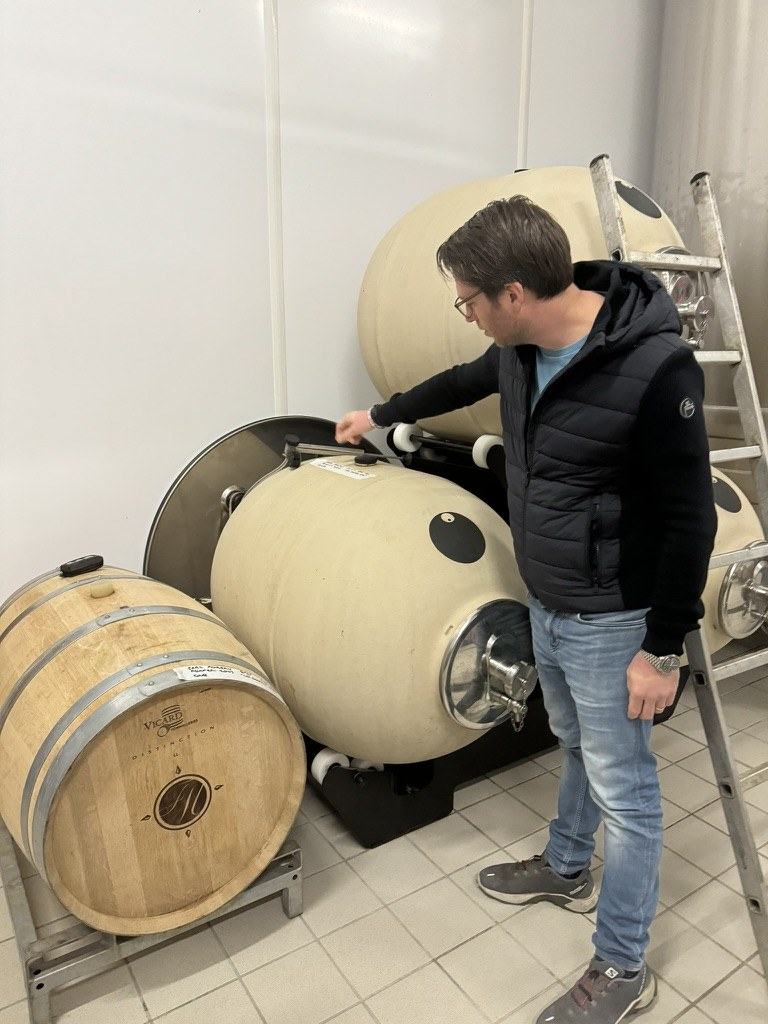
Alexandre Salmon trained as a winemaker, came back to Chaumuzy in 2003 and has spent two decades dismantling the idea that an Ardre-valley grower makes one cheerful brut and goes home. The vineyard came first. The family had farmed raisonnée (minimal treatments) long before it was fashionable; under Alexandre the estate went organic, certified by Ecocert from 2020 to 2025, with part of the vineyard worked biodynamically; the tightest old parcels are ploughed by horse. The old Coquard press (the wide, slow, traditional wooden press of Champagne) is still what the grapes go through, and riddling is done by hand or in gyropalettes, never hurried.
In the cellar he vinifies plot by plot and keeps the lots separate until he has tasted every one. Then the dosage comes down, or disappears. The Special Clubs are brut nature, zero grams. The 100% Meunier rosé is now a brut nature too. The house wines sit at seven grams, which is restrained by Champagne’s standards.
The real work is in the single vineyards. Les Grèves, a Meunier parcel at Chaumuzy, was bottled on its own from the 2015 vintage (a blanc de noirs, stainless steel, full malolactic, no dosage), and the same parcel now gives a still white Coteaux Champenois, which almost nobody makes from Meunier. Les Bariolles, planted in 1987 in the next village, came out as a 2017 brut nature with a full-bottle label by the Reims artist Laura Ozymko. L’Orme is the parcel behind the 2017 Special Club. And Le Bouxin gives a still red, unfined and unfiltered, aged in cask: Meunier as a red wine, which the valley drank for centuries before anyone put bubbles in it. Hachette gave the 100% Meunier rosé a coup de cœur two years running, and has started listing the parcel wines under his own name: Alexandre Salmon.
06 · What they say“The rare 100% Meunier white wine.”
Guide Hachette has given the 100% Meunier rosé a coup de cœur two years running, in the 2023 and 2024 editions, and the 2021 Cuvée AS another; the Prestige came within a hair of a third. The Winethologist, tasting at the Printemps des Champagnes in 2024, had waited years to try the house and found it “worth the wait”: the Blanc de Noirs “zesty and full-bodied, with crisp acidity and a persistent finish,” the 2017 Special Club all “brioche, apricot, yellow apple and lemon,” and the single-parcel Les Bariolles “rich and sophisticated.” The Club Trésors shop in Reims introduced the Les Grèves still white with four words: “the rare 100% Meunier white wine.”
The oldest compliment is Rémi Krug’s, and it was meant for the grape rather than the house: Meunier, he said, is “the unacknowledged grape.” Chaumuzy has been acknowledging it for seventy years.
Zesty and full-bodied, with crisp acidity and a persistent finish.
The Winethologist, Printemps des Champagnes 2024, on the 100% Meunier Blanc de Noirs
The Club, and the initials.
Twenty-eight growers, two blind juries.
The Club Trésors de Champagne was founded in 1971 by a dozen growers who wanted a way to prove that a récoltant-manipulant could stand beside the houses. Membership is by invitation, about twenty-eight estates, and every member’s Special Club must be a vintage wine, from estate fruit only, passed by two blind tasting panels before it is allowed into the shared bottle, the squat, heavy Special Club shape. Fail the jury and the wine goes out under your own label, not the Club’s.
Salmon was admitted in 2008 and released its first Special Club, the 2009, in October 2014: three and a half thousand bottles. It was 100% Meunier and zero dosage, which made it one of only three Special Clubs in the Club’s history made entirely from the grape. The 2011 and 2013 followed the same way; the 2017 comes from the single parcel of L’Orme, with a rosé de saignée alongside it. In a club built to show what growers can do, it is the Meunier argument in its purest form.
The one wine without Meunier.
Cuvée AS carries Alexandre Salmon’s initials and is, pointedly, the one champagne in the cellar with no Meunier in it at all: half Chardonnay, half Pinot Noir, from the estate’s few hectares of each at Chaumuzy and in neighbouring Sarcy. The Chardonnay spends twenty months in barrel, the Pinot Noir eight, and the finished blend is dosed at seven grams. The house describes it as a double maturation, wood then bottle, and means it as a gastronomic wine rather than an aperitif.
It reads as a statement of range. A Meunier specialist who can also make a serious, oak-raised Chardonnay-Pinot blend is not a specialist by default; he is one by choice. Hachette gave the 2021 edition a coup de cœur. It is the wine to pour for the sommelier who says, kindly, that they don’t really do Meunier.
In the vineyard
& cellar.
- Holding
- About 10 hectares at Chaumuzy and Sarcy, Vallée de l’Ardre; all estate fruit
- Encépagement
- 85% Meunier; the balance Chardonnay and Pinot Noir
- Soils
- Clay over limestone, with the siliceous meulière stone of the Ardre valley
- Farming
- Lutte raisonnée; organic (Ecocert) 2020–2025, part biodynamic; hand harvest; the old parcels ploughed by horse
- Press & cellar
- Traditional Coquard press; parcels vinified separately; long lees ageing, well past the minimum; riddling by hand or gyropalette
- Dosage
- Zero on the Special Clubs and parcel wines; 7 g/L on the house cuvées
- Membership
- Club Trésors de Champagne since 2008; first Special Club 2009
- Since
- 1953 in the vines; first bottles 1958