
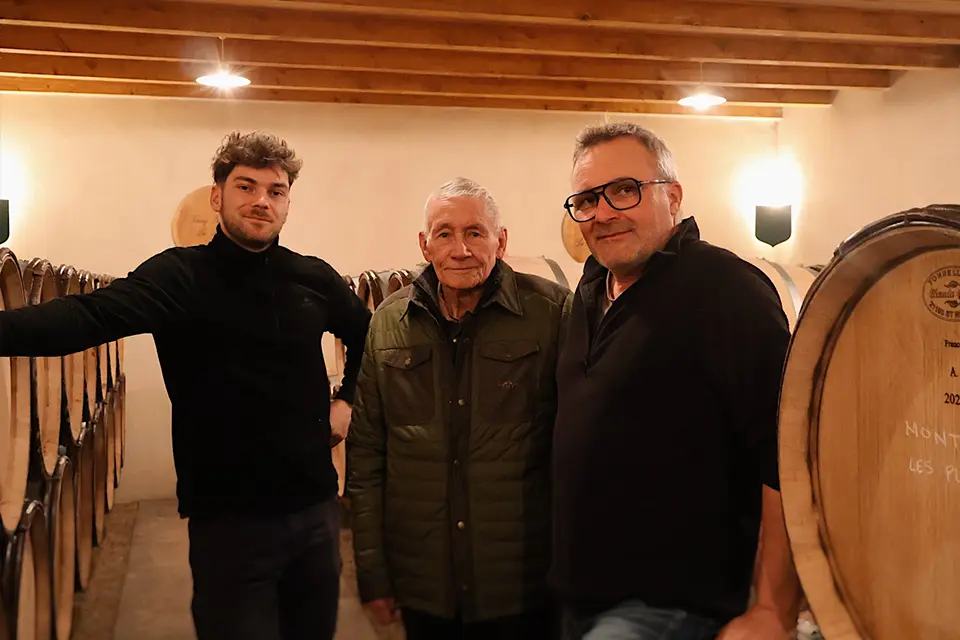
The address I’d want if I were opening a restaurant tomorrow.
Monthélie is the village people drive through on the way to Volnay, and it has been quietly over-delivering for years. The Boigelots have been there since 1918; Eric built his own estate in 1990, and in 2022 his son Charles took it over, having served his time at Coche-Dury and Paul Pillot, an apprenticeship you can hear in the wines the way you can hear a good teacher in a musician. Nine hectares across Meursault, Monthélie, Volnay and Pommard. The whites are mineral and the prices are honest. If I were opening a restaurant tomorrow, this is the address I'd want.
02 · The old cooperageTwo hectares in 1918, a coup de cœur in 1982, and a cellar in the Damy barrel works.
Éric Boigelot’s great-grandfather put two hectares together in Monthélie in 1918, the year the war ended. His grandson Jacques grew it to seven, across Monthélie, Meursault, Volnay and Pommard, and in the Guide Hachette’s memory he is the man whose 1982 Champs Fulliots took a coup de cœur; for years a good part of the family’s grapes went to Coche-Dury. Éric worked beside his father through the eighties and in 1990 set up on his own with three and a half hectares on the plateau above the village (the parcel that is still Les Hauts Brins), and in 1998 moved the cellar down the hill into Meursault, into the old Damy cooperage on the rue des Forges, where the barrels were made before the wine was. He and his wife Patricia have run it from there since; the Hachette noted, as early as the 2006 vintage, that he farmed en lutte raisonnée, and it is HVE-certified now.
Charles started his apprenticeship at fifteen. Two years with Raphaël Coche at Coche-Dury, a year with Éric Germain at Vincent Girardin, a year with Thierry Pillot at Paul Pillot in Chassagne: three of the best cellars in the Côte de Beaune, and three different ideas of how to make white wine. In 2022, at twenty, he came home “to enter the dance, bringing his personal touch to the methods of vinification.” The transition has been the Burgundian kind, progressive and argued over the barrel: father and son, one observer wrote, “don’t quite see eye to eye on the reds, but agree on enough to keep working together.” Charles now leads the vinification of the domaine’s wines, and keeps a few barrels of his own under his own name from parcels his father lets him have, which is how a village learns a new vigneron is serious. The estate’s own statement of intent: “For him, it is above all the terroir and the year that make the wine; the vigneron’s role is to accompany its élevage judiciously.”
Il y a plus de philosophie dans une bouteille que dans tous les livres.
Louis Pasteur — the line over the Boigelot cellar door
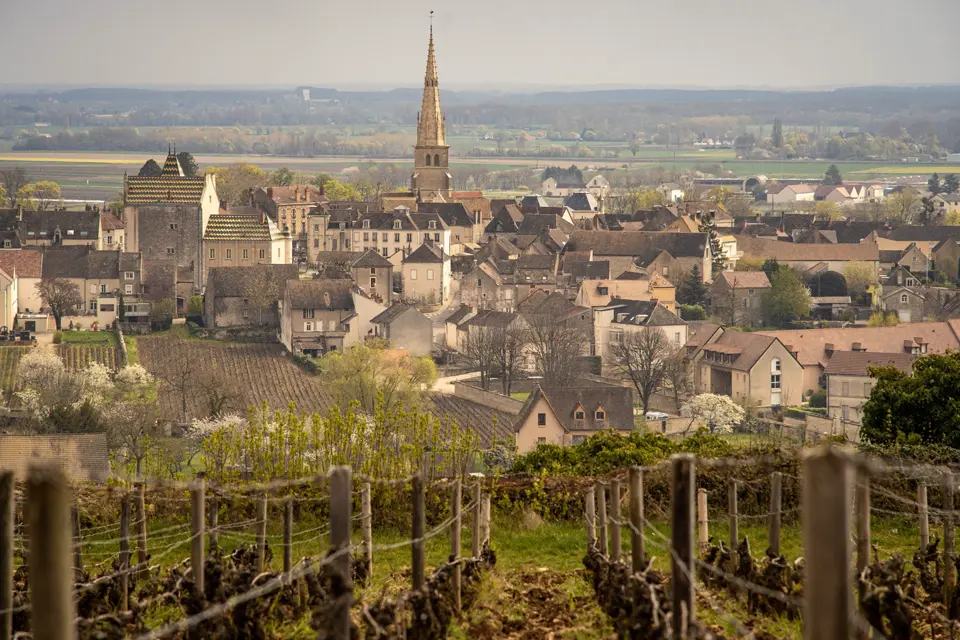
03 · Behind the hillMonthélie’s plateau against Volnay, and a walled clos inside Champs Fulliot.
Monthélie is the fold in the hills between Volnay and Auxey, and the Boigelots’ best ground runs along the Volnay line. Les Hauts Brins is the top of a south-facing plateau at the border, thin topsoil over hard limestone, the original 1990 parcel, red and white both. Le Clou des Chênes is full south at the crown of the plateau, touching Volnay Ez Blanches, more rock than soil. Sur la Velle abuts Volnay’s Clos des Chênes; Le Meix Bataille is deeper marl on the plateau top; with the village Pièces Fittes under the forest they make La Massale, declassified premier cru fruit from three parcels. The Clos des Champs Fulliot is the family’s ancestral plot, one of two walled clos inside the premier cru, south-east on light draining marl (effectively an extension of Clos des Chênes), with vines from the mid-eighties, and it is the wine the Hachette once called en dentelle, in lace. The Vieilles Vignes premier cru gathers the oldest vines, forty and fifty years and some of them the old pinot fin, from La Taupine, Sur la Velle, Champs Fulliot and Clou des Chênes.
On the Meursault side: Les Clous, high and east-facing near the forest line on crumbly clay and limestone, the cool one; Les Petits Charrons on the plain below the village, clay and marl with the iron-red streak of the Rougeots above; and a small south-east piece of Meursault 1er Cru Les Caillerets, continuous with the Volnay Caillerets, loose stone over solid rock. Then Volnay Ez Blanches, high between the forest and the Clos des Chênes on white, thin, intensely calcareous soil, vines from around 1960; Volnay Santenots, on Meursault’s commune and planted to Pinot as the rules allow; and Pommard En Bœuf, a steep south-east hillside at the mouth of the Pommard combe where the cool valley wind comes down from Saint-Romain. And an Aligoté from a single parcel in Les Durots at the Volnay border, the vines ninety to a hundred years old.
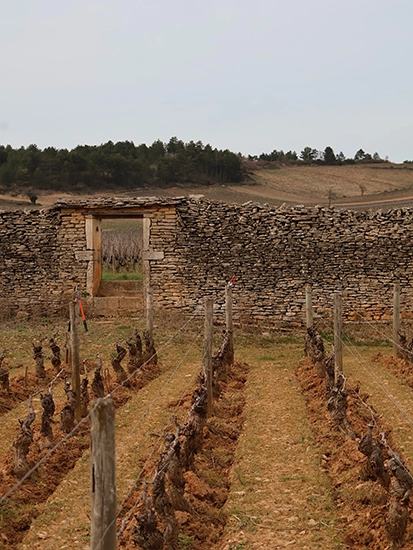
04 · Delicate extraction“More perfume than power.”
The farming is a marriage, in the family’s words, of ancestral knowledge and modernity: the minimum of treatments, and a preference for parcels ringed with dry-stone walls, which shelter the lizards and the insects and, it turns out, the wine. Hand harvest into small crates. The whites ferment in barrel on their own yeasts and sit twelve months on their fine lees, then six in tank (about eighteen months in all), with little new wood; the house style is “clean, pure and mineral,” and it comes out of Les Clous at the top of the slope as clearly as anywhere.
The reds are where father and son have talked longest. Éric made them whole-cluster for years and then went the other way; the domaine’s reds today are fully destemmed, cold-soaked, fermented on indigenous yeasts in steel, and raised twelve months in barrel and three to six in tank, lightly filtered. What Charles has brought from Coche and Pillot is a lighter hand on the cap (a delicate extraction, a long gentle press), and Charles Curtis MW, tasting the 2024s for Decanter, described the result exactly: “light and fine, more perfume than power, but a surprisingly persistent finish… Charles vinifies them gently, with a delicate extraction to avoid harsh, rustic tannins.” In his own barrels he goes further (whole bunches, no sulphur in the vat, used wood only), and some of that will drift across the cellar with time. The point is already made: Monthélie does not have to be rustic to be Monthélie.
For him, it is above all the terroir and the year that make the wine; the vigneron’s role is to accompany its élevage judiciously.
Domaine Éric Boigelot, on Charles
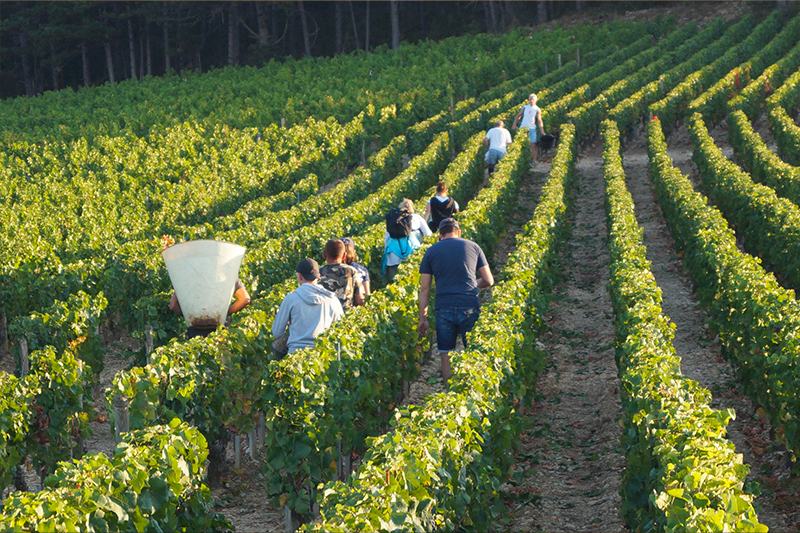
05 · What they say“Remarkably successful for a difficult vintage.”
Charles Curtis MW in Decanter, 93 on the 2024 Clos des Champs Fulliot: “seductive black cherry fruit aromas with a floral edge and a bit of spice… the vines are mature; Eric’s son Charles vinifies them gently… His wines in 2024 are remarkably successful for a difficult vintage.” Steen Öhman of Winehog, who named Charles his talent of the year in 2025 (“one of the largest new talents in Burgundy right now”), on the domaine: “Eric Boigelot makes some very good red wines and a number of very fine whites in a lovely, clean, pure and mineral style,” wines with “an x-factor found only at the best estates in Meursault.” Jancis Robinson on the 2023 Clos des Champs Fulliot: “very intense and bright-fruited; not flattering, more structured.” Bill Nanson on the Aligoté: “saline, round, layered… a beautiful melting flavour. This is excellent!” The Hachette, over twenty years of stars: the 2013 Pommard “a true Pommard for keeping”; the 2009 Clos des Champs Fulliot “a wine in lace”; the 2010 Hauts Brins “elegance over power.”
For a list, the arithmetic is simple. Volnay’s neighbour, Coche-Dury’s former supplier, a cellar in Meursault, and prices that still say Monthélie.
Light and fine, more perfume than power, but a surprisingly persistent finish.
Charles Curtis MW, Decanter, on the 2024 Clos des Champs Fulliot
In the vineyard
& cellar.
- Holding
- Nine hectares in Monthélie, Meursault, Volnay and Pommard; Chardonnay, Pinot Noir and a parcel of century-old Aligoté; cellar in the old Damy cooperage, rue des Forges, Meursault
- Since
- Family domaine from 1918; Jacques Boigelot; Éric’s own estate from 1990, moved to Meursault 1998; Charles beside him from 2022 and now leading the vinification
- Training
- Charles: two years at Coche-Dury, a year at Vincent Girardin, a year at Paul Pillot
- Farming
- HVE level 3 (Bureau Veritas); minimum treatments; dry-stone-walled parcels kept for biodiversity; hand harvest into small crates
- Whites
- Barrel-fermented on indigenous yeasts; twelve months on fine lees in barrel, six in tank; little new oak
- Reds
- Destemmed; cold soak; indigenous yeasts in steel; gentle extraction and a long soft press; twelve months in barrel, three to six in tank; light filtration