
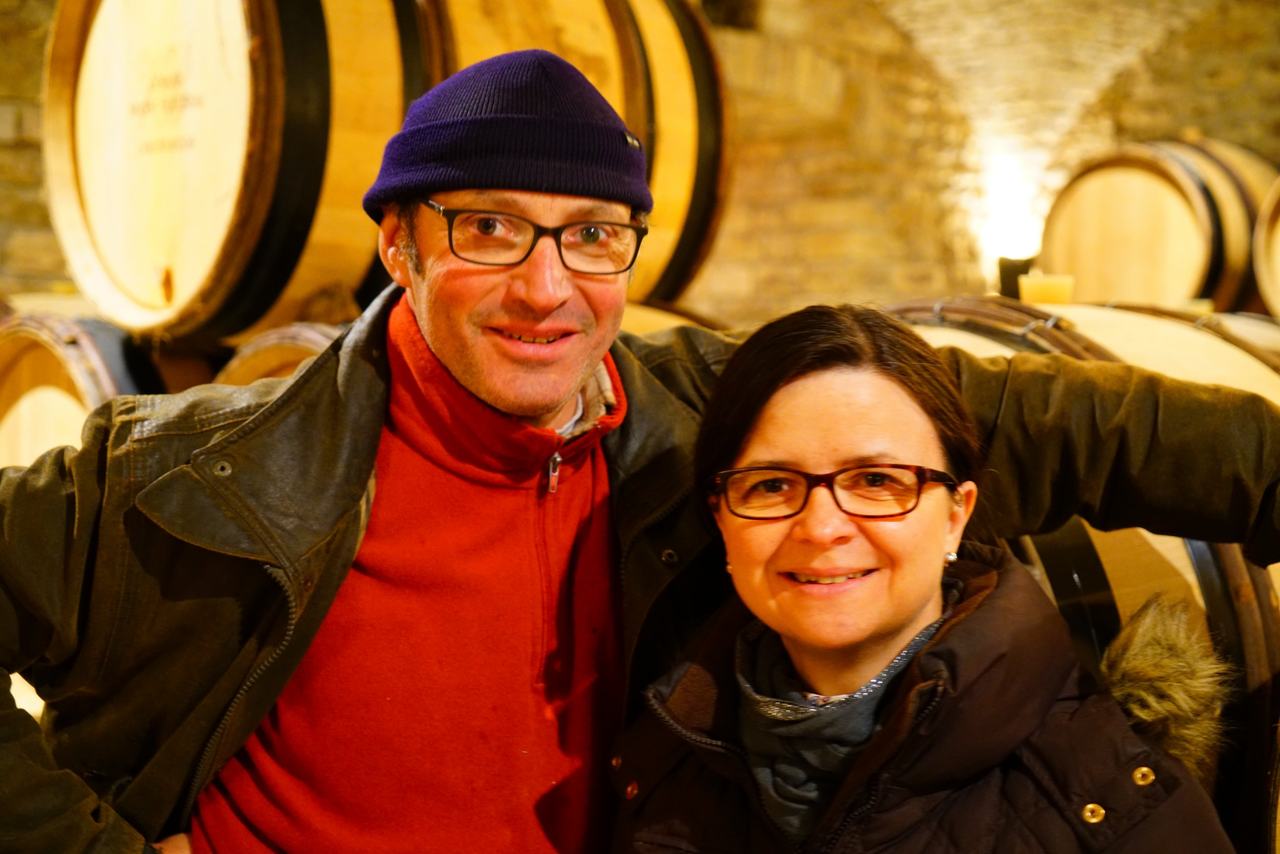
It takes confidence to make wines this quiet.
Ten generations of Bouzereaus in Meursault, which is long enough that the family has stopped needing to prove anything. Vincent has run it with his wife Aline since 1990: ten hectares scattered across eight villages of the Côte de Beaune, worked with cane pruning, de-budding and green harvest, all of it aimed at less fruit and better fruit. The house style is deliberately undemonstrative; the oak stays in the background and the site does the talking. It takes confidence to make wines this quiet.
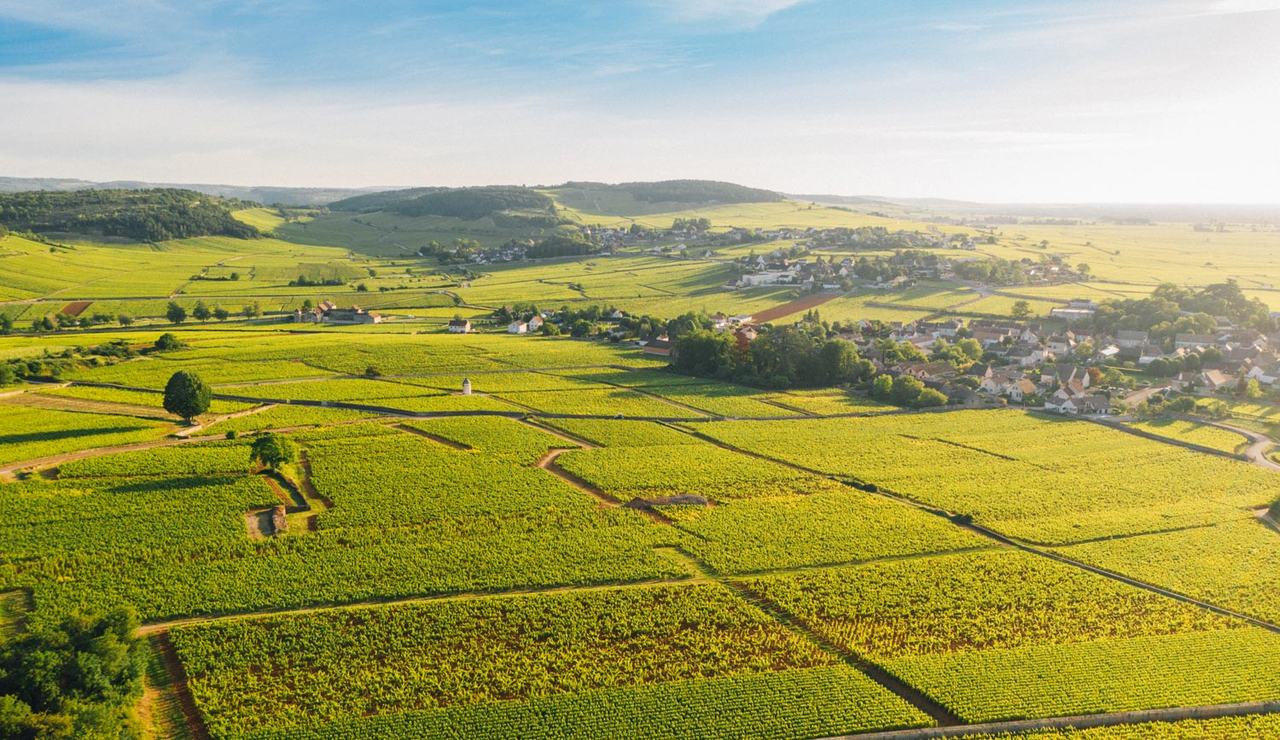
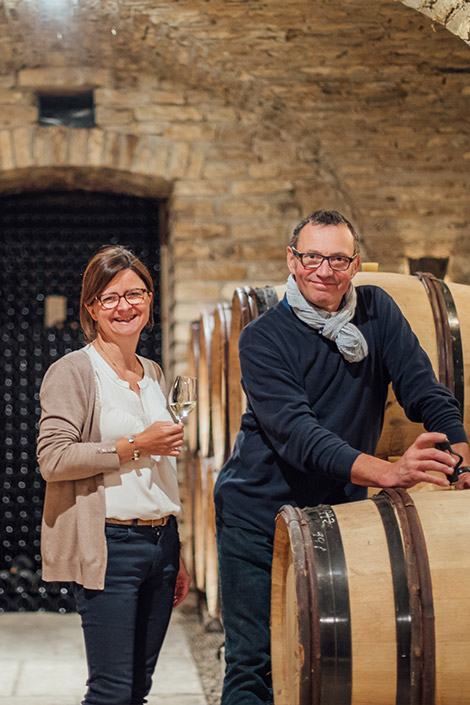
02 · Shake a bush in MeursaultA stonemason, a steward of the château, and a helicopter carrier.
Jasper Morris’s line is the one everyone quotes: shake a bush in Meursault and a Bouzereau will fall out. There are five domaines of the name in the village and they are all cousins. This branch writes its own tree back to Pierre Bouzereau, 1812 to 1892, a stonemason and compagnon du devoir who kept a few vines on the side; his son Edme was steward of the Château de Meursault and kept a few more; Edmond, 1875 to 1953, was the first to call himself a vigneron and own what he worked; Robert, 1905 to 1984, had two sons, Michel and Pierre, who split in 1971 as the family does every generation: dans notre famille, on sépare à chaque génération. Pierre Bouzereau-Emonin, born 1938, is Vincent’s father, and the Emonin half of the name is a Volnay line of coopers and wine brokers whose Champans and Santenots came down the maternal side. Vincent’s grandmother brought the Santenots; the Champans was his maternal grandfather’s cuvée chérie. He says the family has been in Meursault four hundred years, and tells the neighbours who complain about the hunting horns: “They will have to deal with it.”
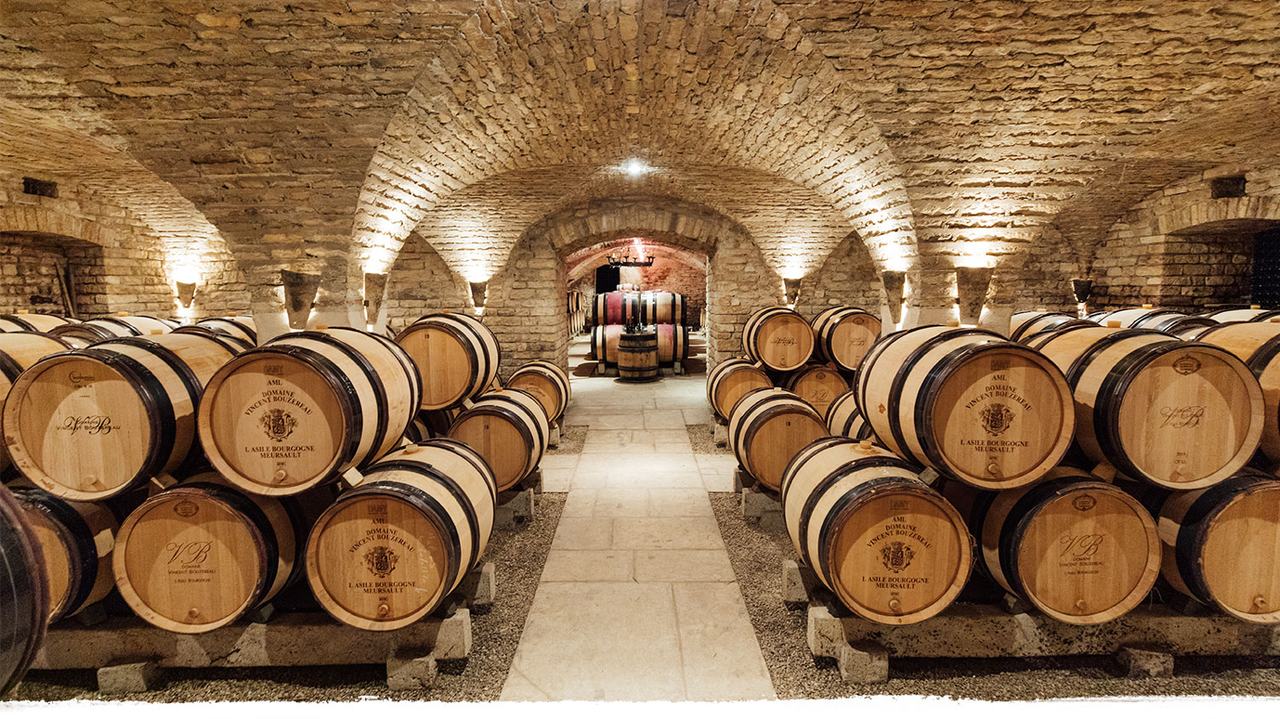
Vincent was the eldest grandchild, born in the maternity ward of the Hospices de Beaune, did his viticulture and oenology at Beaune, worked in the Valais and in America, and spent his national service on a French navy helicopter carrier, which took him around the world and sent him home. He started in 1990, first beside his brother Jean-Marie (who has his own domaine now) and then alone: an Aligoté parcel and the Monthélie Jouères were his first purchases, the Auxey Bas des Duresses soon after. Aline is from the Hautes-Côtes de Nuits, daughter and granddaughter of négociants (her father ran the house of Edouard Delaunay, her brother Laurent runs it today), and “her father was a fine taster who taught her to find all the richness and complexity of aromas in wine.” She runs the sales, the office, and the clients in three languages. In 1992 the two of them bought l’Asile Bourgogne, an old Meursault property the Hachette calls the former priory of the château, restored the house and cuverie and dug new cellars in dressed stone. Six children; Louis, the fourth, trained at Trapet in Gevrey, Cheveau in the Mâconnais, in Australia and South Africa, and works full-time; Clotilde, the eldest, helps run the office. “We are both great dreamers,” they say, “and thirsty for projects. That is what gets us up in the morning.”
Je suis de ces vignerons qui vont dans leurs vignes.
Vincent Bouzereau
03 · Eight villagesFrom the Goutte d’Or to a walled fifteen ares of Corton.
Ten hectares, fifteen kilometres from end to end, four grapes. In Meursault the village wine is a dozen parcels on the slopes (Vireuils, Clous, Gruyaches, the Charrons), averaging forty-five years, and Les Narvaux is three parcels above the premiers crus at the top of the hill, stony, one of them replanted by Vincent’s father in the seventies on ground that had been abandoned since phylloxera, always vinified apart. The premiers crus are the family’s heart: the Goutte d’Or, the original parcel, on the magnesian limestone that puts silver in the colour; Les Charmes, an old family plot and one bought in 1999, mid-slope, forty-five-year vines, the wine the Hachette has given four coups de cœur; and Le Poruzot, two parcels of seventy-year vines bought from 2003 that Vincent says have “the elegance of the Goutte d’Or and the matter of the Charmes.” Over the line, Puligny Folatières in the lieu-dit Au Chaniot, bought by his parents in 1979 when it was half red, since replanted to white.
The reds come from the Volnay side of the family and from Vincent’s own buying: Meursault rouge from a sixty-five-year parcel just below the Santenots; Volnay Santenots, seventy-year vines from his grandmother; Volnay Champans, mid-slope, his grandfather’s favourite; Pommard Les Chanlins high at the upper limit of the premiers crus on marl and limestone; Beaune Pertuizots, a hectare south toward Pommard in three plantings of the family’s own selection; the Auxey Bas des Duresses, never replanted, sixty years old; the Monthélie Jouères, east-facing on the Auxey border. And at the exit of Aloxe-Corton, fifteen ares of Clos des Fiètres, bought in 2003, walled, between Perrières and Chaumes on red clay gravel, shared with exactly one other owner: seventy-year Pinot for the red and a block Vincent replanted to Chardonnay for a white Corton whose first vintage was 2008. Everything on the property is planted from the family’s massal selections, chosen the day before harvest, Vincent and his father walking the healthiest vines for the finest canes, “a practice uncommon among domaines, which often prefer clonal selection.”
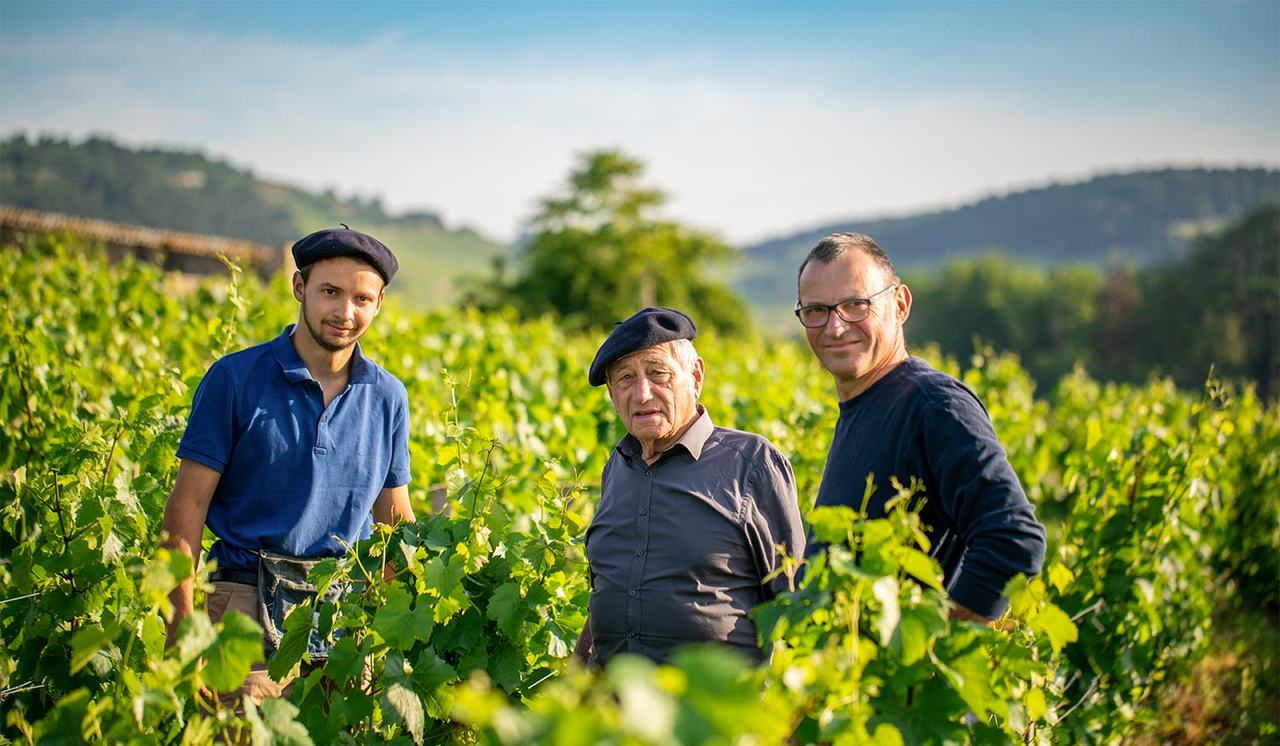
04 · Beautiful grapes“Pour faire une belle bouteille, il faut de beaux raisins.”
The year is the old Meursault year: winter pruning to a single Guyot cane, subsoiling, spring ploughing, tying and hoeing, the de-budding the village calls échetonnage adjusted to each vine’s age and vigour, trellising, replacing the dead, hedging, a green harvest if the vine has been generous, and treatments en lutte raisonnée “so as to listen to the vine.” Hand harvest, parcel by parcel at ripeness, a sorting table for the reds. Then the whites are pressed on arrival, settled cold for a day, and go straight to barrel in the cellar, where they ferment on their own yeasts at whatever temperature the cellar is (no yeast, no enzymes), and stay fifteen to eighteen months on the lees, racked after the malo, stirred “according to the vintage.” A quarter to a third new oak on the Meursaults, a third on the crus, none on the Bourgognes. Here the barrel is a vessel, and the Hachette’s recurring note is boisé bien dosé.
The reds are destemmed, some without crushing, and ferment in open vats with a daily punch-down and pump-over by the vintage, except the Passetoutgrain, the Coteaux and the Corton rouge, which are pumped over twice a day and never punched, “to keep the fruit.” Fifteen to eighteen months in barrel, a quarter to thirty per cent new. Filtration “light or non-existent,” bottling at the domaine by the moon. The motto is painted on the website: pour faire une belle bouteille, il faut de beaux raisins, and the theology behind it is Vincent’s too: every bunch “a gift of nature, a gift of God.” The point of all the work, he says, is to open the bottles with other people, in the cellar or around a table of home cooking; the house rule is that if you work hard you must eat and drink well.
Pour faire une belle bouteille, il faut de beaux raisins.
Domaine Vincent Bouzereau
05 · What they say“Il moissonne les étoiles du Guide.”
The Guide Hachette has given the Charmes a coup de cœur four times (2009, 2013, 2015 and the 2010 two stars besides) and summed the domaine up in a line: il moissonne les étoiles du Guide, he harvests the Guide’s stars. On the 2015 Charmes: “diablement gourmand… white flowers, buttered brioche, ripe pear; ample, suave and rich without heaviness, underlined from end to end by a fine acidity.” The white Corton Clos des Fiètres took a coup de cœur for 2010 (“the fat and the power expected of a Corton, held up by a freshness that is very much present… a remarkable balance for this grand cru”) and the red Fiètres two stars for 2020, “a small climat beside Perrières formidably illustrated by this Meursault grower.” The 2022 village Meursault “failed the coup de cœur by a hair”: “an energetic attack, a fat and powerful middle, a slender, mouth-watering, long, dynamic finish.” Bill Nanson of the Burgundy Report, tasting the 2016s: of the village, “very Meursault… long in the finish, very tasty”; of the Narvaux, “really delicious!”; of the Goutte d’Or, “melting rocks over the palate, layers of textured, melting flavour. Excellent wine!” Of the 2014 village: “I think I’d guess Meursault blind — which is a compliment.”
Nanson’s remark is the whole case. In a village where half the wines taste of the winemaker’s ambitions, these taste of Meursault, and they are priced by a family that “holds to keeping prices reasonable against the market.” The Aligoté alone (“engaging, indeed delicious”) is reason to call.
I think I’d guess Meursault blind — which is a compliment.
Bill Nanson, Burgundy Report
In the vineyard
& cellar.
- Holding
- About ten hectares in eight villages (Meursault, Puligny, Auxey, Monthélie, Volnay, Pommard, Beaune, Aloxe-Corton) in Chardonnay, Pinot Noir, Aligoté and Gamay; everything from the family’s massal selections
- Since
- Bouzereaus documented in Meursault from Pierre, born 1812; Vincent from 1990 with Aline; l’Asile Bourgogne bought and restored 1992; son Louis now full-time, daughter Clotilde in the office
- Farming
- Lutte raisonnée; single Guyot, de-budding by vine age and vigour, green harvest when needed; soils worked; massal cuttings chosen the day before harvest; hand-picked parcel by parcel
- Whites
- Pressed on arrival, 24 hours’ cold settling, fermented in barrel on native yeasts at cellar temperature; 15–18 months on lees for Meursault and above; 25–30% new on village and Narvaux, 30% on crus, none on Bourgogne; Aligoté half in steel
- Reds
- Sorting table; destemmed, some uncrushed; open vats with temperature control; daily punch-down and pump-over (pump-over only on Passetoutgrain, Coteaux and Corton rouge); 15–18 months, 25–30% new
- Bottling
- Light or no filtration; at the domaine, by the lunar calendar