
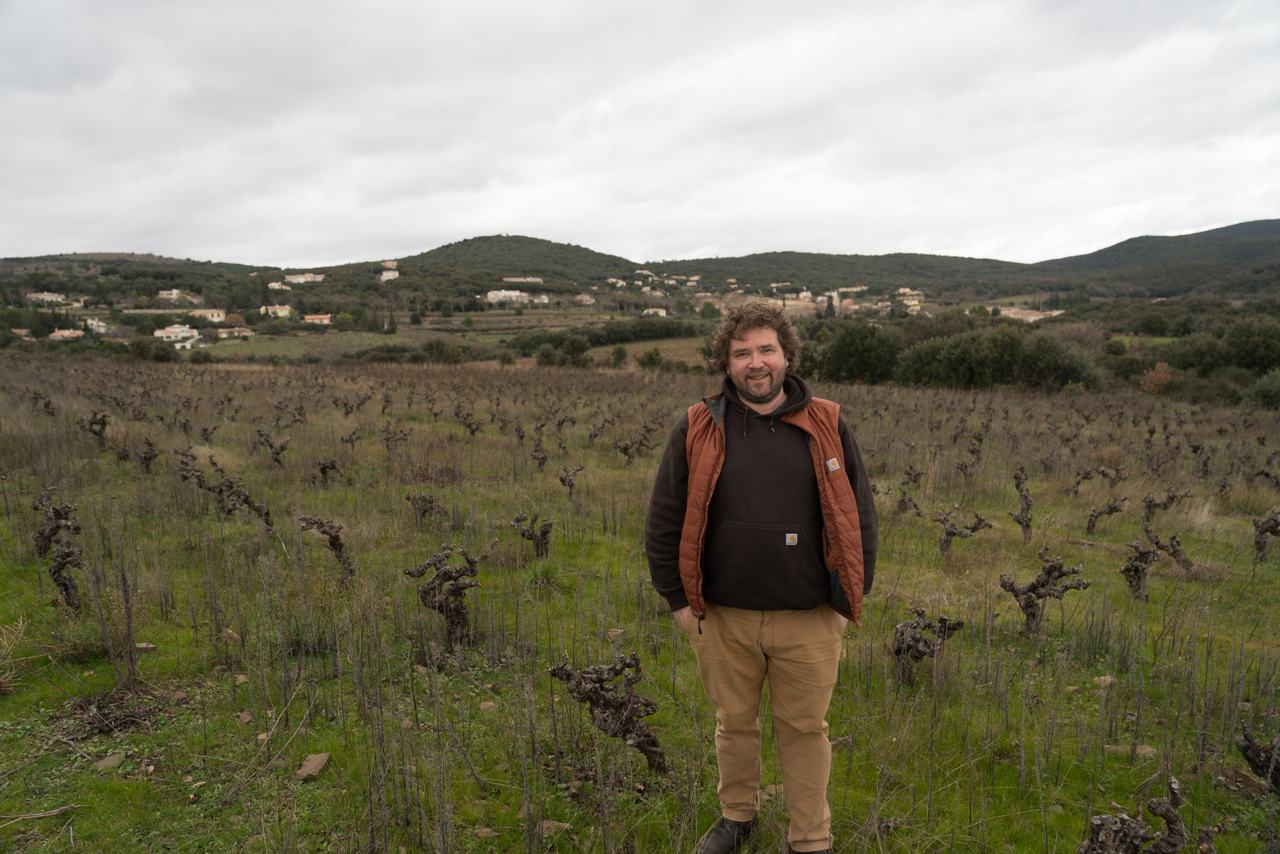
Faugères, re-evaluated.
Faugères is schist, nothing but schist: a black flaking rock that holds heat and gives wine a wiry, mineral tension you don't otherwise find in the south. In late 2012 Frédéric took on old vines that had already been farmed organically since 1997, and set himself a fairly nervy goal: to redefine what the appellation tastes like. Less extraction, less oak, less everything. Half whole-bunch, ambient ferments, old wood, near-zero sulfur. The wines came out fresh and vibrating and unlike their neighbours, and Faugères has been re-evaluated ever since.
02 · The EldoradoNormandy, a finance degree in Lille, Ottawa, Burgundy by proxy, and then the oldest organic vines in Faugères.
Frédéric Brouca grew up tramping the Norman bocage and wanting to be a gentleman farmer; his family is Gascon and fed him well, and a friend of the family, the restaurateur Marcelle Pérotin, taught him wine. He studied finance in Lille and met Elaine, a Canadian, there; at the end of the degree the choice was plain. “Either I made a lucrative career to secure a gilded retirement fast, or I followed my passion. I quickly understood I could never resign myself to the first.” He moved to Canada, took his sommelier certificate at Algonquin College in Ottawa and taught there, worked a vintage at a Niagara winery, and became an agent selling Burgundy growers’ wines in North America and Asia, a job that took the family through Canada, India, Singapore and the United States and taught him, from the buying side, exactly what he wanted a wine to be.
“It was the Eldorado of wine!” he says of the Languedoc, a land of possibility with a viticulture older than France. He chose Faugères for its schist and for the growers he admired there. At the end of 2012 he found what he calls the oldest organic vines in the appellation, ten hectares around Laurens certified since 1997, and bought them; the first vintage, 2013, was made in a small stone cellar in the middle of the village. There are three children, Olivia, Malcom and Thibaud, and the family divides its time between Faugères and Miami. “Oui,” he says, “je suis complètement mordu de Faugères.”
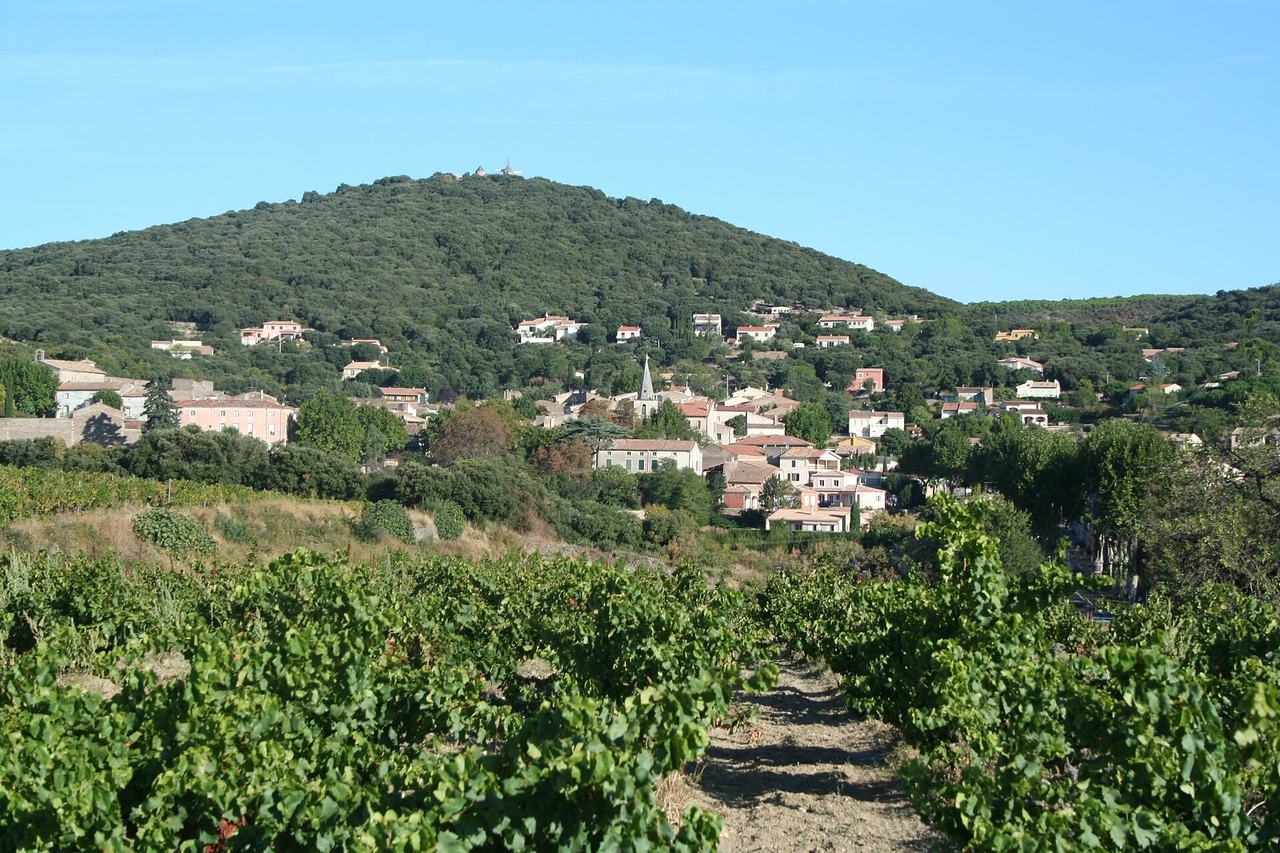
Qu’est-ce que c’est beau, ici ! On a la montagne dans notre dos, la mer Méditerranée en face de nous.
Frédéric Brouca
03 · SchistChamps Pentus, the two clos at Sauveplane, and a hill called La Serre.
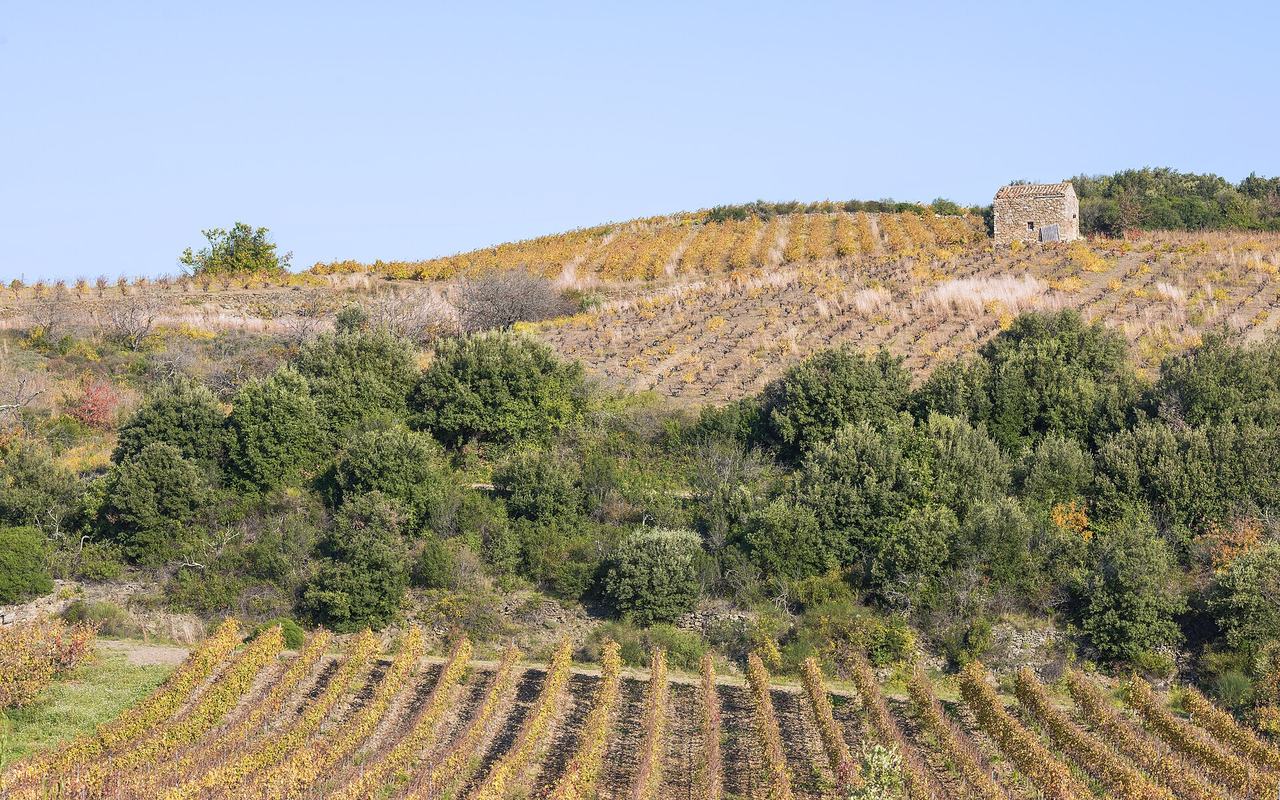
Ten hectares of gobelet-trained, unirrigated old vines on the black schist of the Faugères hills, yields around twenty-five hectolitres. Champs Pentus (the steep fields) is the heart of it: thirty-year-and-older Grenache, Syrah and Carignan on slopes facing south and south-east, the blend shifting a little by year. Clos Sauveplane is two walled clos on the plateau at the eastern edge of the appellation, schist and red clay, where he planted Mourvèdre densely, seven thousand vines to the hectare, beside Syrah of more than forty years; the two are picked and fermented together, three parts Mourvèdre to one of Syrah, and the wine is made only in years that deserve it, about two hundred cases. On the hill of La Serre, forty-five-year-old bush-vine Cinsault becomes Samsó Seulle (Samsó is the grape’s old name in the local tongue), and old Grenache, Carignan and Syrah become Côte de Glou, which is, he says, a state of mind rather than a place.
Foulage Gaulois (Gallic treading, with the feet) is the one wine not from Faugères: a Pinot Noir from an organic hillside at Saint-Chinian, bought in and foot-trodden, aged in tank and amphora. And there is a vermouth.
04 · Vins vivantsPicked early, sorted in the rows, trodden by foot, no sulphur to speak of.
Organic with Ecocert since 1997 on the old parcels; sulphur and a little copper against the fungi, teas of plants and essential oils, no insecticide ever: “from the earthworm to the fox there has been a balance since the dawn of time; it must be respected.” Grass nearly all year, one or two shallow passes with a small tracked tractor to spare the soil, compost once a year. He picks two or three weeks before his neighbours, by hand into fifteen-kilo crates, sorting in the row, for acidity and against jamminess.
The cellar is gravity-fed and the wines are what he calls vins vivants: destemmed but not crushed with a share of whole bunches (a fifth in Champs Pentus, more in the Cinsault, everything in the clos), on indigenous yeasts only, which he calls “the pet that fascinates me most; they make the soul of a wine.” Short daily pump-overs, then after ten or fifteen days the grapes are trodden by foot. Champs Pentus spends ten to twelve months mostly in conical steel with a tenth in neutral barrel; Clos Sauveplane twelve to fourteen in foudre and old barrels. Sulphur is near zero (“sulphur alters the taste of wine”): a homeopathic dose after malo or at bottling, none at all on Côte de Glou and some years of the clos; but he draws the line where it should be drawn: “excess phenols or volatility, and mousiness, are disqualifying.” Nothing fined or filtered. The vermouth is Grenache, Carignan and Terret Blanc with local thyme, rosemary, lavender, rose petal, orange peel and honey, a fifth of it aged in barrels left out in the sun. Serve it neat on ice with orange rind; he would rather you did not put it in a cocktail.
Il faut que le vin vive pour que le vin vibre.
Frédéric Brouca
05 · What they say“Energetic, authentic and sensitively made.”
The Canadian critics at WineAlign have followed him from the first vintage. John Szabo MS, 93 on the 2020 Clos Sauveplane: “fresh black forest fruits, blackberry coulis, wild violets and cracked black peppercorn”; one of Brouca’s best to date. Sara d’Amato, 92 on the 2018 Champs Pentus: “A clean, juicy and lightly salty blend of grenache, syrah and carignan… Energetic, authentic and sensitively made.” David Lawrason, 91: “very expressive, interesting and rather juicy… floral violet notes with plummy/black cherry fruit, pepper and a touch of meatiness.” On the Samsó Seulle, four critics between 90 and 92: “a notably pure expression of grape variety,” “excellent fruit concentration and length,” “authentic and honest.” Jacky Blisson MW: “a thoughtful natural wine producer crafting reds of precision and depth.” Decanter on Côte de Glou: “all those garrigue herbs and smoked meat.” And Natalie MacLean, on the very first Champs Pentus, 91: it “rocks.”
Reds of precision and depth.
Jacky Blisson MW
In the vineyard
& cellar.
- Holding
- About ten hectares of old gobelet vines on schist at Laurens, AOP Faugères: Champs Pentus (south and south-east slopes), the two Clos Sauveplane on the eastern plateau, the hill of La Serre; ~25 hl/ha, dry-farmed
- Since
- Frédéric Brouca, with Elaine; vines taken on at the end of 2012, first vintage 2013; the parcels organic since 1997
- Grapes
- Grenache, Syrah, Carignan, Mourvèdre, Cinsault; Terret Blanc, Vermentino, Grenache blanc, Roussanne; Pinot Noir bought in from Saint-Chinian for Foulage Gaulois
- Farming
- Organic, Ecocert; sulphur and under 2 kg copper; plant teas; no insecticide; grass cover, light tracked tractor; compost; hand harvest early into 15-kilo crates, sorted in the row
- Cellar
- Gravity; destemmed uncrushed with 20–100% whole bunch by cuvée; indigenous yeasts; short pump-overs, foot-treading after 10–15 days; Champs Pentus 10–12 months in conical steel with 10% neutral barrel; Clos Sauveplane 12–14 months in foudre and old barrels
- Sulphur
- Near zero: 20–25 mg/l total on the Faugères, none on Côte de Glou; unfined, unfiltered
- Vermouth
- Grenache, Carignan, Terret Blanc; thyme, rosemary, lavender, rose, orange peel, honey; a fifth sun-aged in barrel; 17%