
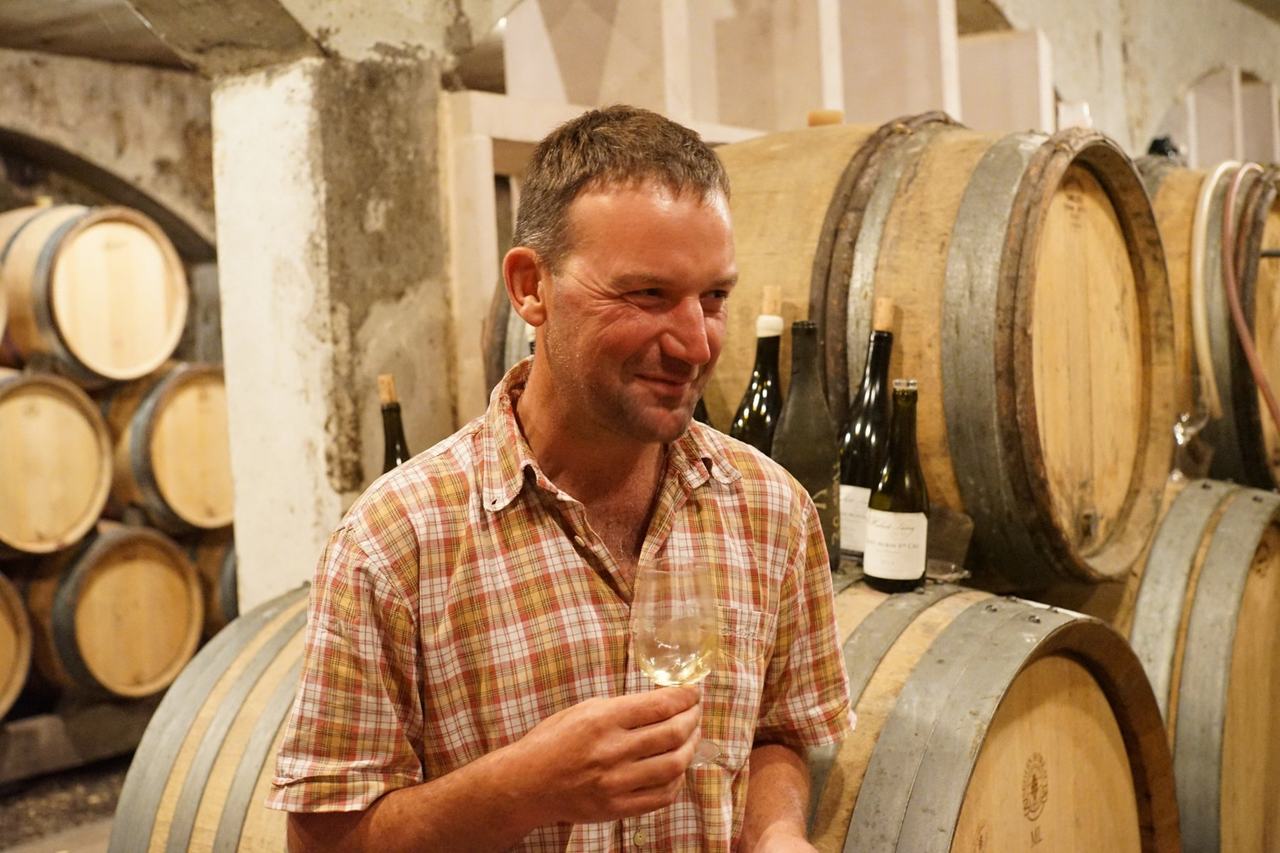
Still, technically, a Saint-Aubin producer.
The Lamys have farmed here since 1640, but it's what Olivier has done since taking over that put Saint-Aubin on the map: planting vines at densities nobody thought sane, up to thirty thousand per hectare, so the roots have to fight each other and go down instead of out. The Haute Densité cuvées that come off those blocks are now among the most sought-after white Burgundies alive, aged twenty-four months, raised in everything from demi-muids to glass globes to amphorae. In July MICHELIN gave him Three Grapes: one of nine estates in all of Burgundy, beside DRC, Leroy, Coche-Dury and Roumier. He is still, technically, a Saint-Aubin producer. Let that sit for a moment.
02 · Seven childrenA lottery ticket, a scooter, and the keys at twenty-five.
Lamys have grown vines in Saint-Aubin since 1640, but the domaine is young. Grandfather Jean’s seven hectares were split among seven children, and in 1973 Hubert Lamy took his share (a few hectares, mostly Aligoté and Passetoutgrains sold off to the Beaune négociants) and started bottling under his own name. The seed money, by one of the better Burgundy stories, was a lottery prize: at sixteen Hubert won two million old francs at Dijon’s Quinzaine commerciale, bought a scooter, bought presents for his brothers and sisters, and put the rest into vines.
Olivier was born that year, 1973. He finished school in 1993, did his army service, interned with Méo-Camuzet in Vosne-Romanée in 1995, and came home. By 1996 he was effectively running the place and from 1997 every bottle was domaine-bottled. His own account of the handover, to the Bien Public: Il m’a laissé les clefs à vingt-cinq ans. Il m’a laissé faire mes choix, parfois des bêtises, tout en continuant de travailler. He gave me the keys at twenty-five, let me make my own choices, sometimes mistakes, and kept working. Hubert kept working until he died in October 2022. Olivier’s wife Karine, from the Tollot-Beaut family in Chorey, runs the office; a new three-level gravity cellar was finished the autumn after Hubert died.
Il m’a laissé les clefs à vingt-cinq ans. Il m’a laissé faire mes choix, parfois des bêtises.
Olivier Lamy, on his father
03 · Thirty thousandThe roots have to compete. The grapes are very small.
The arithmetic Olivier likes to recite: before phylloxera Burgundy was planted en foule, around thirty thousand vines to the hectare, in no rows at all; the horse brought it down to fourteen thousand; the tractor to ten. Since 1995 he has replanted everything at fourteen thousand, the horse-era figure. Then, in the 2000s, he went back to the beginning. At the top of Derrière chez Edouard, on a slope so steep it is worked with a hand tiller hauled by a winch from the top, he planted a tenth of a hectare at twenty-eight to thirty thousand vines: rows a metre apart, three vines to the metre, two buds to the vine. “The roots have to compete very much,” he says, “and the grapes are very small.” What you taste, in his words, is “less from the grapes themselves, more from the rock.” It makes about one barrel a year, and the first bottling was 2006. He has since done the same at Les Tremblots in Puligny, twenty-seven thousand to the hectare, and in the sliver of Criots-Bâtard-Montrachet, by interplanting new rows between the 1975 vines.
He is honest about the cost (three times the work per hectare, “a very expensive wine to produce”) and about what it is not: “When it comes to making wine we haven’t really invented anything.” The rest of the farming is the same discipline at normal density: no herbicide since the early 2000s, every parcel ploughed, no chemical fertiliser in twenty years, Guyot-Poussard pruning, massale selection, trellises carried high and the shoots braided rather than hedged. Uncertified, and he will say so; in 2012 one spray that was not organic saved the crop. William Kelley’s view of the Haute Densité, 94–96+: “full-bodied, multidimensional and strikingly concentrated, it’s layered and elegantly muscular.”
The roots have to compete very much, and the grapes are very small.
Olivier Lamy
04 · The hillsideAbove Le Montrachet, bordering Chevalier.
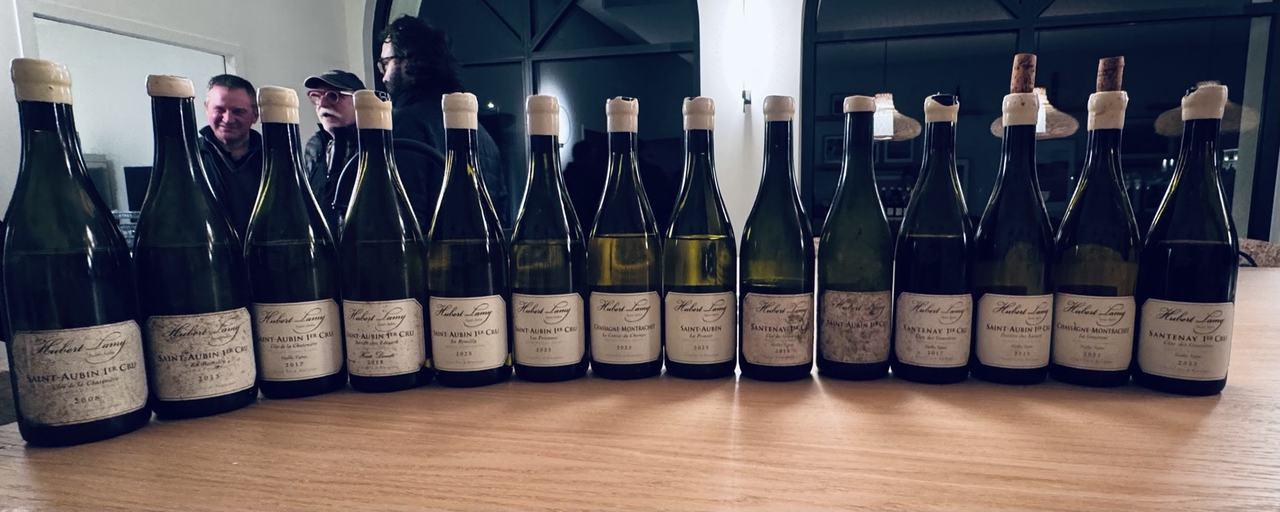
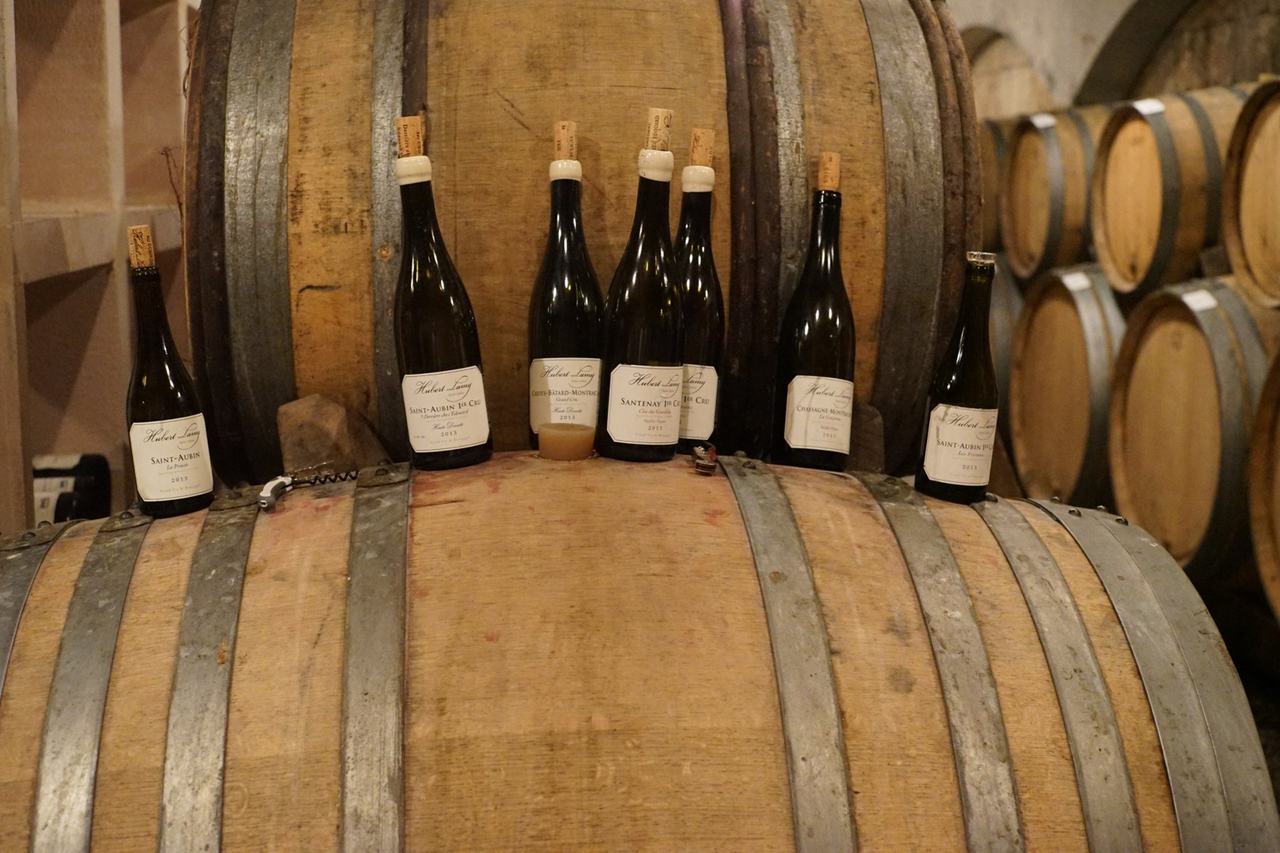
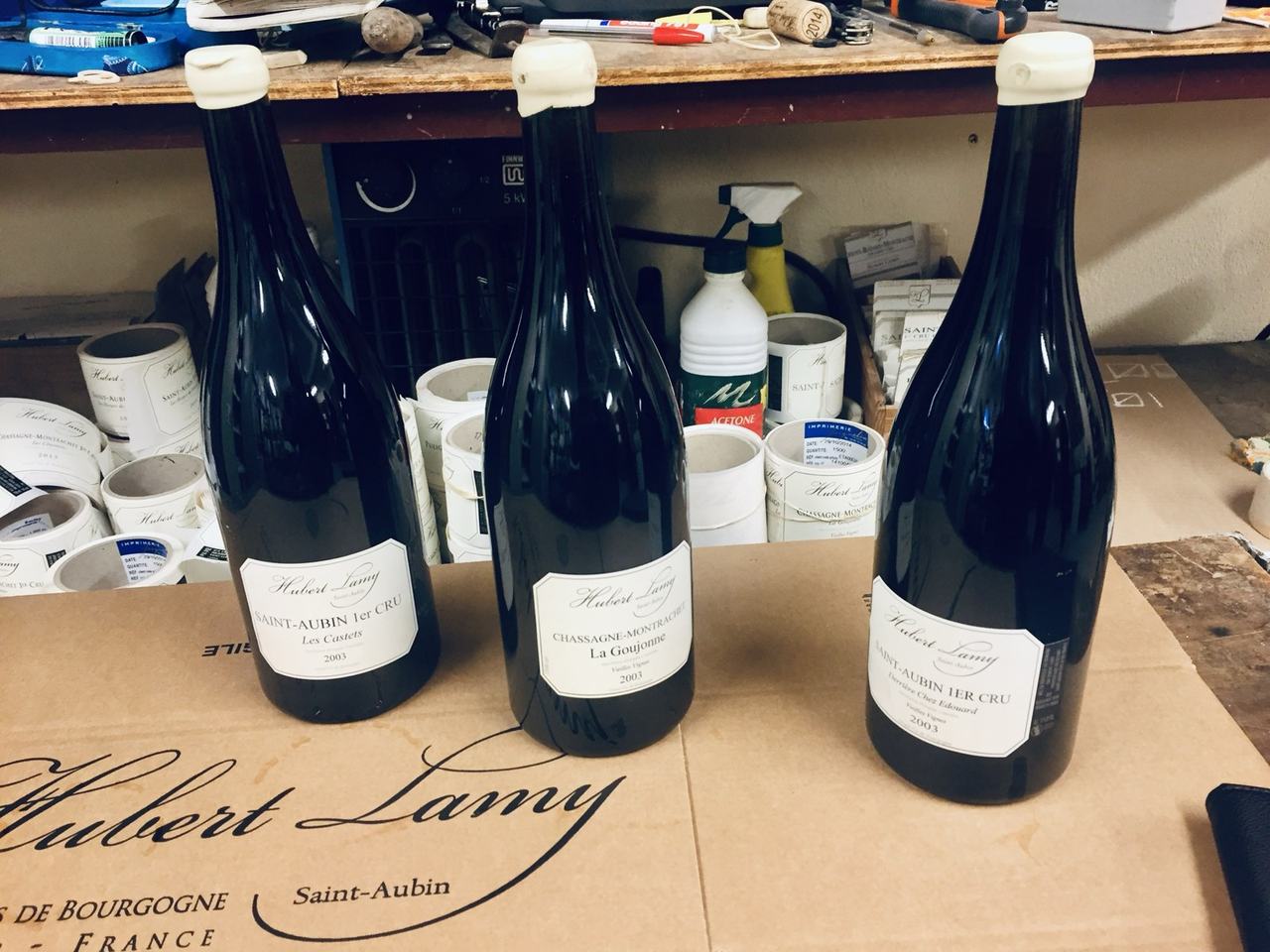
Saint-Aubin is the village wedged behind Puligny and Chassagne, up the combe, and its best vines look straight at the grands crus. En Remilly, two hectares planted 1989, is the flagship: a steep south-facing slope of shallow limestone directly above Le Montrachet and bordering Chevalier. Les Murgers des Dents de Chien is next door, a quarter-hectare at three hundred metres, named for the dog-tooth stones in it. Clos de la Chatenière is a true clos (Lamy is the only producer who labels it), bought in 1992, planted by Olivier’s uncle in 1964 on a forty-per-cent south-facing slope of iron-rich stone; Olivier will tell you the name comes from chêne, not chestnut. Les Frionnes holds the oldest vines, from 1935, on Kimmeridgian scree; Hubert replanted part of it to Pinot in 1980 and Olivier grafted it back to Chardonnay in 1995. Derrière chez Edouard is the cool south-east slope with the high-density block at its crown and a hectare of 1960 Pinot Noir below. Clos du Meix sits at the foot of the hill.
Then the neighbours: Puligny Les Tremblots, 1946 and 1970 vines below Bâtard on white-pebbled marl; Chassagne Les Chaumées and Les Macherelles; a hectare of 1950 Pinot in La Goujonne; Santenay Clos des Gravières and Clos des Hâtes; and five ares of Criots-Bâtard-Montrachet, leased, on the southern edge of Bâtard, bottled by hand. Eighteen and a half hectares, eighty per cent Chardonnay, three families of soil (white marl at the top, harder limestone lower down on the sunny sites, decomposed Kimmeridgian scree) and about two hectares too steep for a tractor.
05 · Big barrels, long timeTwenty-four months in wood, six more in tank, no stirring.
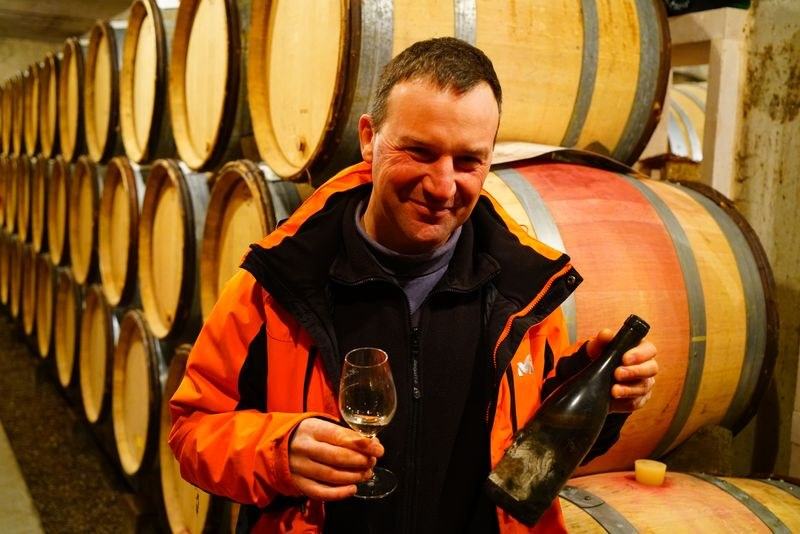
Olivier was among the first in the Côte de Beaune to abandon the barrique: six-hundred-litre demi-muids from 1996, when the first pneumatic press arrived, then 350-litre barrels, 1,800-litre foudres, and lately glass globes and amphorae. New oak fell from thirty per cent in 2005 to under fifteen, and in 2021 to none on the whites. The grapes are crushed before a slow pressing, settled only lightly (more solids kept since 2006) and fermented on ambient yeasts in a cold cellar, which makes the fermentation long. Then two years on the lees in wood, never stirred, and six months in tank. Sulphur goes in only during the ageing, after the first year, and he admits he once cut it too far, in the late nineties. The wines are shown only after bottling, under DIAM and wax. He keeps a small laboratory of the same wine under different closures, because “there are clear taste differences between the cork types.”
The reds, once destemmed, now go fifty to a hundred per cent whole cluster (eighty in 2020) with a fortnight on the skins and the same long élevage; Sylvain Pataille, in Marsannay, has been a sounding board. Jasper Morris, who ranks Olivier “one of the handful of Burgundy’s finest white wine makers,” now adds: “The reds are now a serious proposition chez Lamy, though there are few of them.”
06 · What they say“One of the handful of Burgundy’s finest white wine makers.”
Jasper Morris: “There is no question but that Olivier Lamy is one of the handful of Burgundy’s finest white wine makers,” and of the 2020s, whites “as magical as expected,” picked earlier than the neighbours yet at higher sugars thanks to “exceptionally meticulous vineyard work.” Allen Meadows on the 2023s: “excellent, and should you come across an offering for them, don’t hesitate.” Neal Martin: “there is a reason why Lamy’s wines are so revered,” and on the 2020 Derrière chez Edouard, “a surfeit of energy on the finish — a seriously fine Saint-Aubin.” Antonio Galloni, back in 2012, when the secret was still a secret: “one of the great, not yet widely discovered domaines in all of Burgundy.” Jancis Robinson: “particularly precise.”
The Haute Densité is allocated by the bottle; about two dozen reach the United States in a year. The rest of the range is why the domaine matters to a restaurant: Saint-Aubin premier cru at the quality of the village over the hill, from a man who says, without irony, “nowadays we work our vineyards in exactly the same way as they do in Puligny or Chassagne.”
There is no question but that Olivier Lamy is one of the handful of Burgundy’s finest white wine makers.
Jasper Morris MW
In the vineyard
& cellar.
- Holding
- 18.5 hectares, 80% Chardonnay, about 110,000 bottles across twenty appellations: Saint-Aubin, Puligny, Chassagne, Santenay, and five ares of Criots-Bâtard-Montrachet
- Since
- Family in Saint-Aubin from 1640; domaine created by Hubert Lamy in 1973; Olivier from 1995, domaine-bottled from 1997
- Density
- Replanting at 14,000 vines per hectare since 1995; Haute Densité blocks at 27–30,000 in Derrière chez Edouard, Les Tremblots and Criots
- Farming
- Organic methods, uncertified; no herbicide, all parcels ploughed, winch on the steep ground; Guyot-Poussard; massale selection; high trellising, shoots braided
- Whites
- Crushed, slow pneumatic press, light settling; ambient yeasts in a cold cellar; 350-litre barrels, 600-litre demi-muids, 1,800-litre foudres, glass globes, amphorae; 0–15% new; 24 months on lees unstirred plus 6 in tank; sulphur only in the second year; DIAM, wax
- Reds
- 50–100% whole cluster, about fifteen days on skins, 0–20% new oak, same élevage