
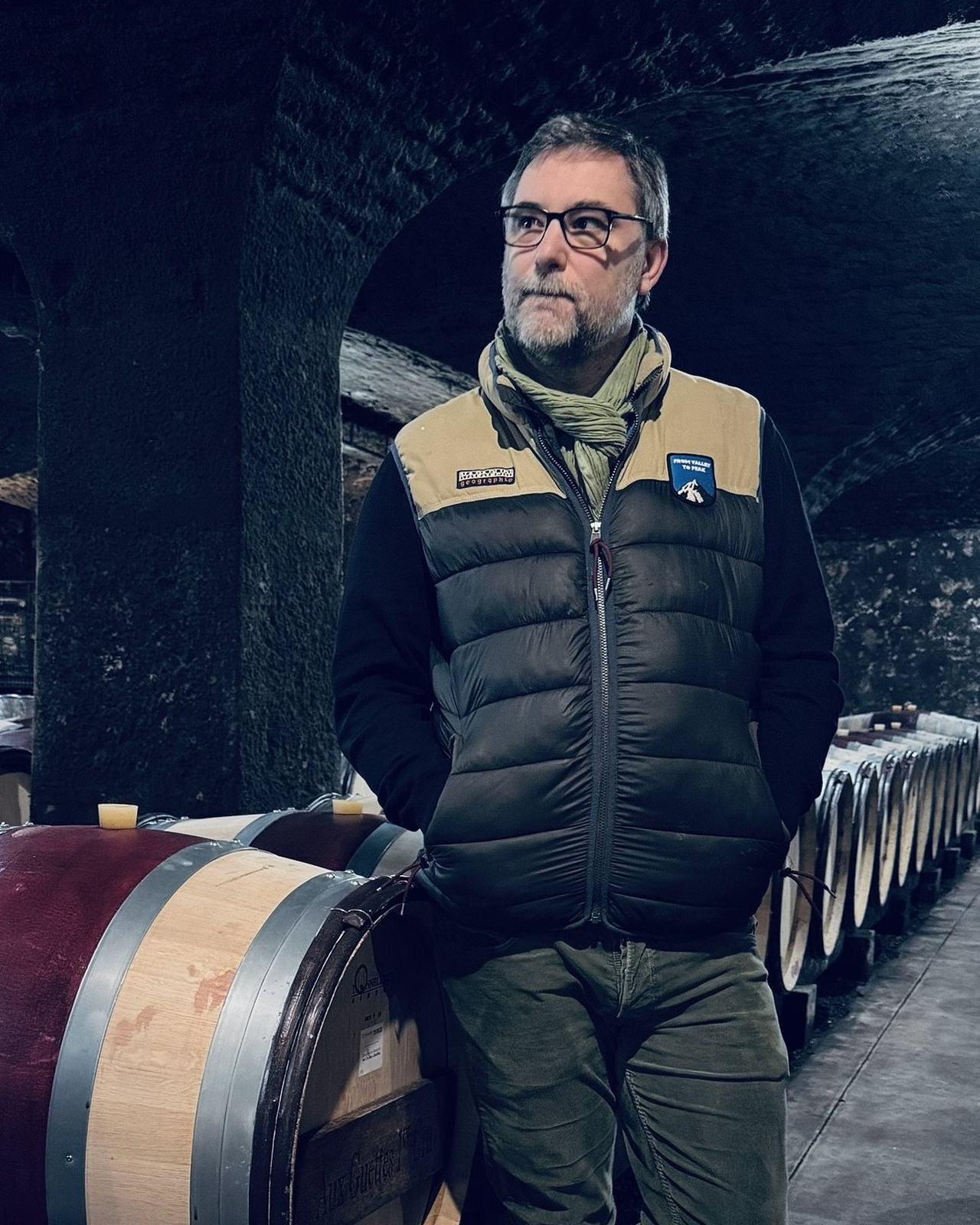
Savigny has never needed to be fashionable.
The Pavelots were farming these slopes before the Revolution, which puts most "heritage" claims in perspective. Thirteen hectares, mostly Savigny, and a flagship, La Dominode, from vines planted just after the First World War, on the southern hillside where Savigny stops being charming and starts being serious. Structured, dark, deeply of its site, made in a style so traditional it has come back around to being radical: cover crops, ploughing, restrictive pruning, hand harvest with the first sort done out among the rows. Savigny is not fashionable. Savigny has never needed to be.
02 · Continuity“It was about doing an equally good job.”
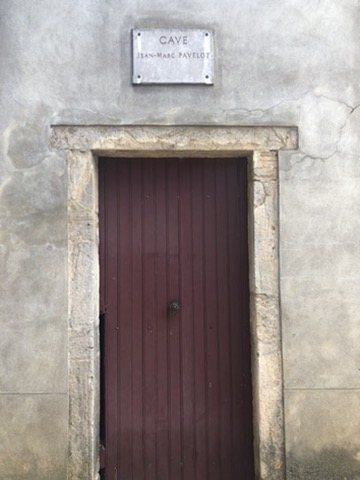
There is a Claude Pavelot growing vines in Pernand around 1700, and the line has passed father to son since 1789. But the domaine as a domaine begins with Henri Alfred Pavelot, 1872 to 1949, the great-grandfather. “Like everybody else at the time they had a little bit of vineyards,” Pierre-Yves Pavelot says. “The main part of the production were other crops. Our great-grandfather and great-grandmother developed the vineyard side of the domaine and started selling in bottle.” Jean-Marc took it the rest of the way: until about 1990 a quarter of the wine still went to the Beaune négociants; by the time his son came home none of it did. In 1988 he bought the old vines in Aux Gravains, and around 1989 he bought the cuverie and cellar on the main road from the house of La Reine Pédauque, whose people kept the rooms upstairs for years afterward. He is past retirement age and still in the vines every day.
Hugues studied in Beaune, worked in Australia and Oregon, and came back at the turn of the millennium; his name went on the label beside his father’s soon after. He says his most important school was Jean-Marc. His brother Pierre-Yves trained as a biologist, took a job here that he did not expect to last, and has been co-owner since 2013. In 2014, after the hail years, Hugues added a small négoce under his own name (Chorey, Pernand, Volnay, Saint-Romain, “accessible appellations” bought as grapes), and in 2021 the family took on three hectares from the Écard domaine, which is how thirteen hectares became seventeen. Hugues’s son Louis is in his mid-twenties and will take over in due time. Asked what the ambition was, Hugues gives the least fashionable answer in Burgundy: “It was all about taking over from our father, who already did a good job. It was about doing an equally good job. Continuity is what it is all about.”
Continuity is what it is all about.
Hugues Pavelot
03 · Two sides of the RhoinSix premiers crus, and a secondary alluvial fan.
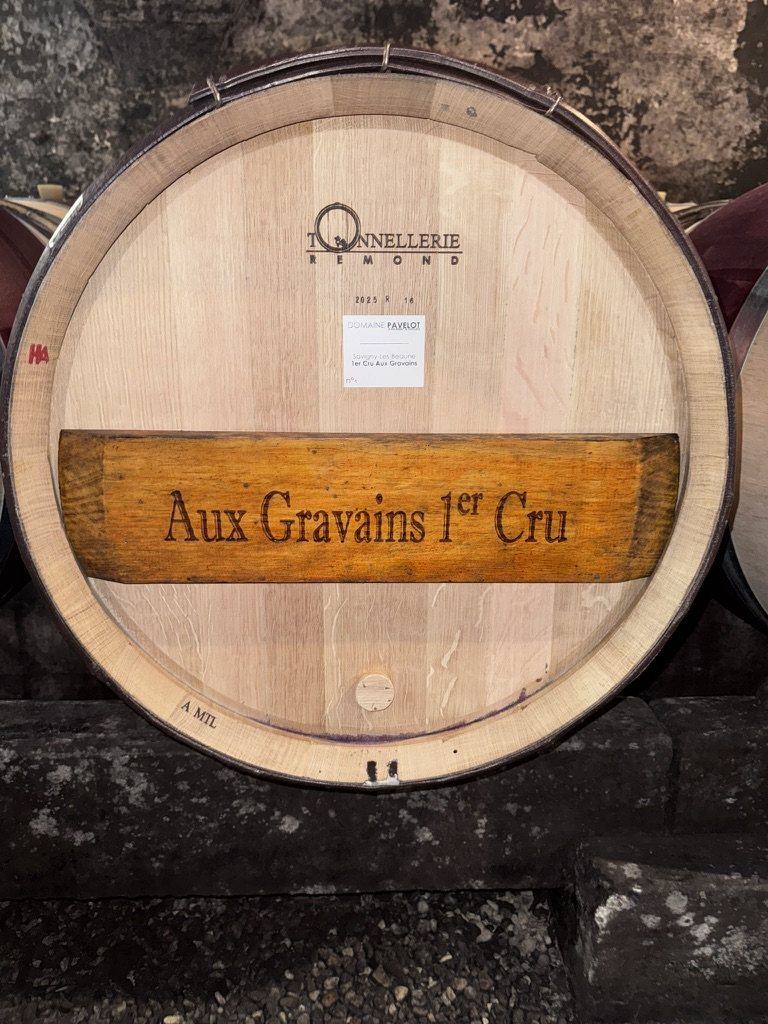
Savigny sits at the mouth of the Rhoin under the Mont Battois, with vines on three sides of it and a hundred and forty metres between the lowest and the highest, which can mean a week’s difference in the picking. Hugues explains the village with a geology lesson: one main alluvial fan built every vineyard in Savigny, and then a second, smaller one came down the Combe d’Orange, and “if you follow the direction of the Combe d’Orange, you come to Aux Gravains.” Four of the family’s premiers crus face south on the Pernand side (Aux Guettes, Aux Serpentières, Aux Gravains, Les Lavières) and two sit across the valley on the Beaune side, Les Peuillets facing south-east and La Dominode facing north-east, both nearer the motorway.
Aux Guettes is up behind the village on twenty or thirty centimetres of soil over rock, one and a half hectares of low yields: “it doesn’t have the volume of Aux Gravains or La Dominode, but it does have a nice length and persistence — more tight than large.” Aux Gravains is the gravel the name describes, deep and drained, a hectare and thirty now, some vines ninety years old. Les Lavières, bought in 2011 (“then it hailed each year!”), is the deeper clay over the flat roofing-stones the village was once quarried for. Serpentières was seventeen ares until the Écard parcel made it a hectare, sixty-year vines on deep marl. Peuillets is sandy, stony, and thirsty: “there is little clay, so there are no reserves.” And La Dominode, two hectares and twenty-two, is the one the essay above is about: known as Dominode or Dominaudes for two hundred years, though the map calls it Les Jarrons, two-thirds planted seventy or eighty years ago on sand and clay, the rest in the seventies and the 2000s. “More complex,” is all Hugues will say, “but there is sand there as well.” Above all of it, a single barrel of Corton blanc from an old quarry under Charlemagne, vines the family got back in 2008.
04 · Dry tannins are not allowedThe same guidelines for a Bourgogne and a premier cru.
Organic, certified in 2024, after decades of ploughing and grass and restraint: “high-yielding vines have never been planted at the domaine,” Hugues says, and Pierre-Yves adds that the fine clones “are not easy to work with. They are more sensitive and they are more difficult to prune.” Hand harvest, the first sort out among the rows (in 2013 the team “dropped all the dry stuff at the vines”), then a vibrating table and a second sort at the cuverie. The village wine is fifteen parcels, Gollardes, Guetottes, Bas Liards, Pimentiers, Champs Chardons, Picotins, Rouvrettes, each vinified apart. “We taste and then we blend.”
The cellar is deliberately plain. The village and Bourgogne are destemmed; the premiers crus take fifteen to twenty-five per cent whole bunches since the middle of the last decade, “to bring the more crunchy fruit characteristic”; twenty in Serpentières, up to thirty in La Dominode. Grapes not crushed, a cool soak of about five days, ambient yeasts, a fortnight in vat with punch-downs for the first four or five days and pump-overs after. Ten months in barrel for the village wines, twelve for the crus; no new oak on the village, fifteen to thirty per cent on the premiers crus, La Dominode getting the most. No fining, a light filtration when a wine asks for it. Hugues on the point of it: “We have the same guidelines for all our wines, whether it is a Bourgogne rouge or a premier cru. We strive to favour the fruit, the freshness. That is the essence of the Pinot Noir. And to go with that, there is a certain kind of tannin we are looking for, always silky tannins. Dry tannins are not allowed.” And: “During vinification the terroir speaks for itself. Between a Savigny village and a premier cru like Dominode there is an undeniable difference. We are just here to unveil that.”
Always silky tannins. Dry tannins are not allowed.
Hugues Pavelot
05 · What they say“Right at the top of the price/quality curve.”
Bill Nanson, Burgundy Report, who has followed the domaine for twenty years: “This domaine is right at the top of the price/quality curve.” Allen Meadows on the 2022 La Dominode, 94+: “This is almost always Pavelot’s best wine… excellent density with an appealing sleekness that carries over to the mineral-driven, powerful and compact finale… very clearly built-to-age”; on the 2022 Gravains, 93, “like rolling tiny rocks around the mouth.” Jasper Morris MW on the 2023 Dominode, 91–94: “so intense in all compartments. Then surprisingly racy on the palate… fresh cherry and raspberry, underpinned by a crystalline limestone notion.” Neal Martin, on the 2015s: “yet another outstanding 2015 from Domaine Pavelot who frankly has done little wrong this vintage”; on the 2021 Dominode, 92–94, “a focused, peppery finish that leaves the mouth tingling for sixty seconds afterwards. Bon vin.” John Gilman: “Often, the Dominode chez Pavelot is my favorite premier cru in the cellar,” and of the 2017, 94+, “This is serious juice.” Decanter gave the 2018 Guettes and the 2018 Dominode 94 apiece: “it’s tricky to choose between Hugues Pavelot’s Savigny premiers crus, such is their consistent quality.” The Guide Hachette has given the Serpentières two coups de cœur and the 2018 Gravains a third.
What nobody writes, because it is not news, is that these are premier cru Burgundies of real seriousness from a village the fashion has passed over. Hugues has a saying for the Guettes, “always more Guettes than the vintage,” and the Dominode, he will tell you, is often a simple wine when young. Give it five years.
This is almost always Pavelot’s best wine.
Allen Meadows, Burghound, on La Dominode
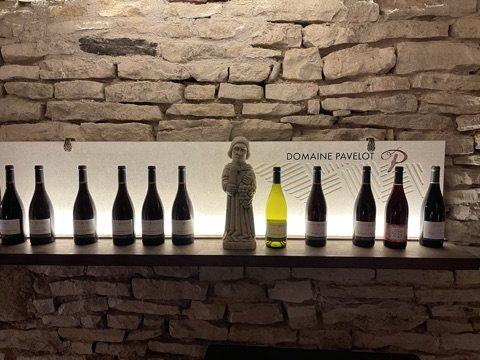
In the vineyard
& cellar.
- Holding
- Seventeen hectares since 2021, fifteen and a half of them in Savigny: 6.5 ha of village red, 1.5 of village white, seven hectares across six premiers crus; Aloxe-Corton Les Cras, Beaune Les Bressandes, Bourgogne, Hautes-Côtes Mont Battois, a barrel of Corton blanc
- Since
- Pavelots in the vines since the 1700s; the domaine built by Henri Alfred Pavelot (1872–1949); Jean-Marc, then Hugues from 2000 and his brother Pierre-Yves, co-owner from 2013
- Farming
- Certified organic (AB) from 2024; ploughing, natural grass cover, strict yields, no productive clones ever planted; hand harvest with the first sort in the rows, then a vibrating table
- Vinification
- Village and Bourgogne destemmed, premiers crus 15–25% whole bunch (up to 30% in La Dominode); grapes uncrushed; five-day cool soak; ambient yeasts; punch-downs for four or five days, then pump-overs; 12–15 days in vat
- Élevage
- Ten months in barrel for the village wines, twelve for the premiers crus; no new oak on village, 15–30% on the crus; no fining, light filtration only when needed
- Négoce
- Maison Hugues Pavelot, from 2014: Chorey Les Beaumonts and Clos Margot, Pernand Les Belles Filles, Volnay, Saint-Romain, Beaune blanc